
THE EGYPTMORE HISTORY GUIDE
Ancient Egypt,
layer by layer.
Travel back through the people, places and ideas that shaped a civilisation. Learn to recognise their traces in Egypt today.
Begin with what survives. Follow a painted wall, a reused stone or a household object back into the world that made it. Scroll down to move toward earlier Egypt, with room to pause and look closely.
Jump to a period or topicQuick orientation · ~2 minFull guide · 14 chapters
العربية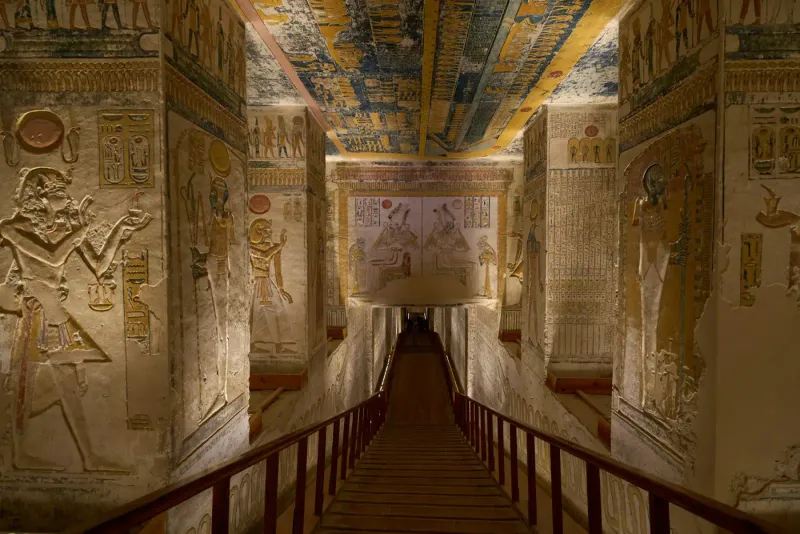
Quick orientation
Ancient Egypt at a glance
Ancient Egyptian civilisation developed along the Nile over thousands of years. A unified early dynastic state emerged around 3100 BCE. The Old Kingdom was the age of the great royal pyramid complexes; the Middle Kingdom saw renewed central rule and major literary traditions; the New Kingdom brought imperial expansion and extensive temple building. Between them, periods of divided rule gave regional courts greater power.
Persian, Macedonian and Ptolemaic rulers, then Roman emperors, governed Egypt in later centuries. When did ancient Egypt end? There is no single date for every part of its history: Roman annexation in 30 BCE ended Ptolemaic rule, while Egyptian language, communities and religious practices continued to change. The last known dated hieroglyphic inscription, at Philae in 394 CE, records one late use of a script. Coptic preserves a later stage of the Egyptian language.
Present → earlier Egypt
Find your way through the guide
Choose a period, follow a topic, or find a name you’ve come across.
Search names, places and the chapter text. Your search stays on this device.
What was a pharaoh?
A pharaoh was a ruler of ancient Egypt whose office joined political authority with religious duties. Kings were expected to uphold maat: the right order of the world, expressed through justice, protection and service to the gods. The word “pharaoh” comes from “great house,” originally the royal establishment. The powers, titles and presentation of kingship changed across Egyptian history.
- The crown
- The double crown joins the emblems of Upper and Lower Egypt.
- The offering
- Temple scenes show the king serving the gods on Egypt’s behalf.
- The royal image
- Pose, scale and regalia express an ideal of rule; appearance also follows artistic conventions.
- The Metropolitan Museum of Art · Kings and Queens of Egypt
- The Metropolitan Museum of Art · The Female Pharaoh Hatshepsut, 29.3.3
Mummification and the afterlife
Preserving the body was an important part of preparing the dead for continued existence in the afterlife. Burial joined care of the body with ritual, offerings and goods for continued life. Coffins, amulets and funerary texts could protect and equip the dead; the resources available shaped what a family could provide.
Preservation methods developed over centuries, from early treatments and wrapping to elaborate embalming. Some procedures removed internal organs, dried the body with natron salts, and used oils, resins and linen. Practices varied by period, place and means, and continued into Roman times. A royal burial represents the resources of a court.
Luxor, the Valley of the Kings and Aswan ↗Gods you will keep seeing
Egyptian gods had overlapping roles and forms. Use these cues alongside inscriptions and the setting of a scene; a headdress alone can be ambiguous.
- Amun / Amun-Re
- Thebes and Karnak; often two tall feathers. Amun-Re joins Amun with the sun god.
- Re / Ra
- The sun god, associated with Heliopolis. Re-Harakhty has a falcon head and solar disc.
- Horus
- Sky and kingship; a falcon or falcon-headed figure. Edfu is a major cult centre.
- Osiris
- Ruler of the dead, closely associated with Abydos; commonly shown with a wrapped body.
- Isis
- Mother of Horus; throne sign or, in some images, cow horns and disc. Look at Philae.
- Hathor
- Music and joy; cow ears or horns. Dendera’s temple is dedicated to her.
- Anubis
- Embalming and protection of the dead; a jackal or jackal-headed figure in funerary scenes.
- Ptah
- Memphis’s creator god and patron of craftspeople; a close-fitting cap and enveloping garment.
- The Metropolitan Museum of Art · The Art of Ancient Egypt: A Resource for Educators
- UCL Digital Egypt · Gods and goddesses in ancient Egypt: local deities
- The Metropolitan Museum of Art · Ptah, 44.4.32
- The Metropolitan Museum of Art · Isis and Horus
- Egyptian Ministry of Tourism and Antiquities · Temple of Dendera
Egypt today Present-day framing
The Egypt you can encounter today
Start with the surviving landscape: a river, inhabited places, damaged monuments and the people who care for them. Then follow the evidence backward.
Find your bearings along the Nile
Upper Egypt is in the south, upstream; Lower Egypt is the northern Delta, where the river branches toward the Mediterranean. The names follow the river’s landscape. Luxor lies in Upper Egypt, while Alexandria belongs to the Mediterranean coast. Memphis, close to modern Cairo, occupied a strategic position near the meeting of valley and Delta. Armies, stone, grain and religious processions moved through this river landscape.
The Nile’s branches shifted, cultivation expanded and settlements grew around channels and higher ground. The Fayum, west of the main valley, received Nile water through the Bahr Yussef; it was connected to river agriculture while having a basin landscape of its own. The accompanying map introduces these regions schematically. Ancient shorelines and political borders varied over time.
Read the Nile from south to north
A geographic overview of the Nile valley and Delta. North stays at the top in both languages.
Choose a place below to highlight it on the map.
Modern geographic reference; ancient channels and shorelines differed. Natural Earth · Terrain: Mapzen / USGS / NOAA
- Delta and Alexandria
Lower Egypt lies downstream in the north.
Read related section - Memphis and Giza
The pyramid region lies near the junction of the valley and Delta.
Read related section - Thebes / Luxor
Karnak belongs to the southern Nile valley, in Upper Egypt.
Read related section - Aswan and Elephantine
Follow the river farther south toward the First Cataract.
Read related section
Figure sources: Reference 1
What survives, and how it survives
At Amarna, mudbrick houses preserve traces of kitchens, storage and workshops beyond the royal monuments. Such buildings generally survive less visibly than a temple’s stone walls, leaving households and their working spaces harder to picture. Excavation brings them into view, but also exposes fragile walls to damage. Protecting a newly uncovered house is part of the work of understanding it.
At Abu Simbel and Philae, the monuments stand in settings created by twentieth-century relocation. UNESCO’s Nubian rescue campaign moved ancient structures to protect them. Elsewhere, stone cut for an early monument was reused in a later building, repaired in antiquity or reset by modern conservators. The history of a standing wall includes these later journeys and repairs as well as its original construction.
The guide distinguishes surviving material, restoration and explanatory reconstruction. Complete outlines in a diagram help explain a plan even where roof shapes, colours or wall heights remain unknown.
White Chapel: reused blocks, reassembled building
Senusret I’s Middle Kingdom chapel was dismantled under Amenhotep III; its blocks became fill in the Third Pylon. Today it is reassembled in Karnak’s Open Air Museum.
- Observed history · reuse
Blocks recovered from the Third Pylon preserve evidence of an older structure. Their positions in the left-hand diagram are symbolic, not a recorded arrangement inside the pylon.
- Documented modern reassembly
The right-hand plan shows the pillar arrangement described by Digital Karnak. It represents the reassembled chapel; it does not claim that every visible part is ancient or distinguish original from modern replacement stone.
- Unknown · original position
The chapel’s ancient location remains debated. Reassembling a building does not establish where it originally stood; no proposed ancient setting is drawn here.
Figure sources: Reference 1
How to read the evidence
An inscribed name can identify the ruler represented on a wall, but it does not by itself date every block in the building. Excavation adds another kind of information: which deposits lay above others, which objects belonged together and which walls cut through earlier structures. A museum object separated from its findspot may retain a readable text yet lose some of these relationships. A good label therefore distinguishes the object’s date, its known or reported origin, and its present collection.
Conservation is research as well as care. Recording a painted surface before treatment can preserve details that a photograph taken years later no longer shows. ARCE’s conservation archives include drawings, images and reports across pharaonic, Christian and Islamic sites. These records make it possible to check what was observed and what was restored. Egyptian archaeologists, conservators, inspectors and skilled workers are central to this continuing work, alongside their international colleagues.
Sources beside each section link to the records behind the account. Approximate dates and disputed identifications are marked in the text. Museum records distinguish an object’s ancient findspot from its present collection; a linked object held overseas is included for study, without implying that it is on display in Egypt.
What this backward journey includes
The reading path moves from the present into Late Antiquity, approximately the fourth to seventh centuries CE, then continues toward earlier Egypt. The intervening Islamic, Ottoman and modern centuries fall outside this guide’s scope. Present-day places provide points of recognition as we trace ancient societies and their transformations.
A dynasty groups rulers; a kingdom or intermediate period describes a broader span of political history. Regional authority and daily life often crossed these boundaries. The opening note on dates sets out our approximate editorial convention and its differences from other chronologies. Dates assigned to individual objects retain the wording of their sources.
Chapters run from newer to older, and their length follows the material discussed. The timeline gives the duration of each period. BCE dates count down toward CE, with no year zero. Across changes of dynasty, religious institution and script, Egyptian communities continued to inhabit and reshape the country.
Late Antiquity Approximately fourth–seventh centuries CE
The ancient world transforms
Churches, monasteries and new written traditions grew within an inhabited Egyptian landscape. Change was profound, uneven and lived across generations.
Egyptian in a new alphabet
Coptic is a later form of the Egyptian language written mainly with Greek letters, supplemented by signs derived from Demotic for sounds Greek could not represent. Hieroglyphs, hieratic and Demotic had recorded earlier stages of Egyptian in different settings. The language developed over time, while scribes adapted its written forms to their work. Coptic texts preserve Christian thought alongside letters and local affairs. Greek remained in use too. The language chosen for a document depended on its purpose, the writer’s education and the community it served; a Greek text could belong to someone who also spoke Egyptian.
At Philae, a hieroglyphic graffito dated 394 CE is the last known example of that writing tradition; the identity of its final readers remains unknown. Centuries later, knowledge of Coptic helped scholars recover the sounds and structure behind older Egyptian writing. Decipherment drew on a language tradition that had continued within Egypt.
A language can change its alphabet
Compare Egyptian language and the scripts used to write it.
- Egyptian language
Coptic is a later form of Egyptian.
- Greek letters
Most Coptic letters come from the Greek alphabet.
- Additional Egyptian signs
Signs derived from Demotic supplied sounds absent from Greek.
Figure sources: Reference 1
The White Monastery near Sohag
Hieroglyphs survive on stones built into the church of St Shenoute at the White Monastery near Sohag. Founded in the fifth century, the church has a basilical interior and substantial stone walls incorporating blocks from older monuments. These pharaonic carvings had already had a history before the stones became part of the church.
Damage, repairs, rebuilding and new paintings changed the church over the centuries. Archaeologists trace those phases by comparing masonry with inscriptions and written accounts. Some phases can be dated only within a range.
Older stone offered builders a valuable supply of worked material. Its religious or royal associations may also have mattered, though the blocks alone leave the builders’ motives uncertain. The masonry establishes the reuse; the reasons for choosing particular stones require other clues.
Work, rules and community in a monastery
Shenoute’s federation linked communities of men and women under their own heads and his wider authority. Alongside prayer, communal life required food and shared work. Rules governed the use of resources and the handling of misconduct, bringing spiritual aims into the daily business of living together. Women’s communities formed part of this organisation, with positions and resources that need to be studied in their own setting. The federation’s preservation of texts and learning took place within demanding hierarchies of leadership and discipline.
Shenoute’s Coptic writings preserve the voice of a leader laying down rules. Repeated prohibitions sometimes suggest the conduct he struggled to control, though they give only his side of communal life. The buildings add other details: how rooms connected, what equipment remained and how spaces changed use.
Tunics, woven bands and repair
A decorated band could outlast the tunic around it and be sewn into another garment. Late Antique textiles from Egypt preserve linen and wool, woven ornament and traces of repair. Reusing a costly insert kept skilled work in circulation after the rest of a garment wore out. Egyptian dress belonged to the wider Mediterranean world even when garments were made locally. In households, cloth was acquired, worn, mended and passed on. Those familiar tasks continued through changes in religious institutions and in the meanings attached to decoration.
Motifs circulated between workshops and communities, so a woven figure rarely identifies its wearer’s religion on its own. Many fragments have lost their full archaeological context. The traditional museum label “Coptic textile” consequently covers objects with varying levels of certainty about date, maker and owner. Fibre, weaving technique and a recorded findspot offer firmer starting points for study.
Roman paintings at Luxor Temple
At Luxor Temple, Roman painted plaster survives over earlier Egyptian decoration in a chamber associated with the imperial cult. The paintings belong to the late third-century setting of Diocletian and the Tetrarchy. They served Roman imperial worship. Egyptian cults and later Christian worship also form part of the site’s history, each with its own setting and chronology.
Removing the painted plaster would expose more of the earlier relief while sacrificing a Roman surface. Conservators must decide how much of each layer to reveal and record. The building-use diagram separates construction, alteration and reuse so that these successive surfaces remain understandable together.
The Late Antique chapter ends at the seventh century, within a much longer history of Egyptian Christian communities and their languages. Its earliest centuries overlap with Roman rule, including the temple alterations discussed here. The next chapter steps back to Egypt’s incorporation into the Roman Empire in 30 BCE.
Roman Egypt 30 BCE–395 CE
Back before Late Antiquity: Roman rule begins in 30 BCE. The chapters overlap where political and religious histories follow different rhythms.
Egypt within the Roman world
Roman government redirected resources and reshaped status while Egyptian temples, households and burial traditions continued to change on their own terms.
An emperor far away, a province close at hand
In 30 BCE, Egypt became a Roman province.
After defeating Antony and Cleopatra, Octavian, later Augustus, governed through a prefect. Authority now lay outside the country, and grain, taxation and transport connected Egyptian farming to the demands of the larger empire.
Egyptian religious practices, Greek writing and goods from imperial trading networks met in the lives of provincial households. Roman administration also reshaped people’s obligations and opportunities: legal standing and social privilege differed between the groups it recognised. These distinctions affected life within a population whose traditions extended well before the conquest.
The division of imperial government provides this chapter’s editorial endpoint in 395 CE. Eastern Roman rule continued afterward, into the world explored in the previous chapter. Within temples, emperors had meanwhile appeared as Egyptian kings, taking their place in ritual imagery far older than Roman control.
Courtyards and grain stores at Karanis
Ovens, grinding equipment and storage jars survive from the houses of Karanis in the Fayum. Grain had to be kept, processed and cooked before it became a meal. These household tools help trace that work through a house; the courtyard could serve as a working space as well as a route between rooms.
A pot found among household equipment can be studied alongside the tools used with it. Reconstructing that household takes attention to layers and findspots: people carried away useful possessions, buildings changed use, and later deposits sometimes mixed material from different episodes.
Storage space, entrances and household equipment varied between the houses at Karanis. Comparing them reveals how different households organised their work and supplies within this Fayum town. Those local differences are a useful starting point for understanding life in Roman Egypt.
Portraits made for burial
The painted portraits often called Fayum portraits were made for the funerary world of Roman Egypt. Wooden panels or painted shrouds accompanied the dead. Painters modelled faces in ways that still seem familiar, using dress, hairstyle and jewellery to shape how a person would be remembered.
These works bring together techniques associated with the Greco-Roman world and practices of burial in Egypt. That combination does not let us read an individual’s ancestry directly from a nose, hairstyle or name. Appearance in art, cultural choices and family origin are related questions, not interchangeable answers.
Technical study has made the paintings less easy to divide into two neat boxes. Wax-based and water-based materials, tools, preparatory layers and local workshop practices require investigation object by object. The Getty-led APPEAR collaboration compares scientific evidence across collections. Such research can correct an inherited catalogue assumption as well as identify a pigment.
Many portraits are held in museums outside Egypt. The linked records give their current collections and, where known, their ancient findspots.
A portrait can carry several traditions
Follow the connections between a portrait panel, a burial and a museum record.
- Paint and support
Portraits used techniques including wax-based encaustic and tempera on wooden panels.
- Funerary purpose
Some panels were placed over the head within mummy wrappings.
- Roman Egyptian context
First–third century CE portraits combine painted likenesses with Egyptian burial practices.
Figure sources: Reference 1
Why Augustus can look like a pharaoh
At the Temple of Dendur, Augustus appears in the visual role of an Egyptian ruler making offerings to deities. The image belongs to the temple’s ritual language. It does not prove that he personally stood there performing each depicted act. A ruler’s presence in a sacred scene expressed the proper relationship between kingship and the gods, while priests carried out the daily service.
Dendur also gives a compact way to understand a temple’s purpose. Rooms became more restricted toward the divine shrine. Access, offerings and the care of sacred images mattered; the building was not designed chiefly as an open congregation hall. Public participation could take other forms, especially when a divine image moved beyond its usual enclosure during festivals. The boundaries between interior service and wider religious life were significant without being the same at every site.
Dendur originated in Nubia. Following the twentieth-century rescue campaign, it was moved to the Metropolitan Museum of Art in New York, where it now stands. Its museum setting forms the latest part of the temple’s history.
What a temple library preserves
At Tebtunis, manuscripts associated with the temple library preserve religious learning in several scripts and copies under Roman rule. People taught, recopied and organised this material within the temple’s institutions. Differences between versions reveal some of the work involved in passing knowledge on.
A manuscript has several dates to consider: when the surviving copy was made, when the work was composed, and the period its text describes. Copyists preserved older works and sometimes modified them. Comparing the wording of several copies helps scholars trace those changes and place each manuscript in its setting.
Written evidence can bring unusual detail while creating its own imbalance. Literate specialists and institutions left more recoverable words than many agricultural workers or children. Their record still depends on the survival of papyrus, the circumstances of discovery and modern dispersal among collections. Pairing a temple text with a household excavation broadens the account; neither source alone stands for the whole province.
Macedonian rule & Ptolemaic Period 332–30 BCE; Ptolemaic kingship from 305 BCE
Cleopatra’s world and its predecessors
Alexandria joined a much older Egyptian landscape. Greek-speaking kings could commission Egyptian temples, while households, priests and traders negotiated a changing society.
Cleopatra VII, 51–30 BCE
Cleopatra VII ruled from 51 to 30 BCE, near the end of the Ptolemaic dynasty. By her time the Giza pyramids were already more than two thousand years old. Her reign belongs to the first-century BCE Mediterranean, where Rome’s growing power shaped the decisions of neighbouring rulers. The defeat of Antony and Cleopatra and the Roman annexation in 30 BCE ended Ptolemaic kingship. Egyptian settlements and agriculture continued under the new administration, along with Egyptian language and temple worship, whose Roman-period forms appear in the preceding chapter.
A queen’s image could work differently on a coin, a statue or a temple wall. A temple representation followed conventions of kingship and divine relationship; a portrait identification may be tentative even when a sculpture looks distinctive.
Why so many temples are later than they look
At Edfu and Dendera, pylons, columned halls and rulers presenting offerings carry Egyptian architectural and religious traditions into the age of Greek-speaking kings. Many familiar forms endured for centuries; inscriptions and building sequences help place them in time.
At Dendera, the standing temple of Hathor belongs to the Ptolemaic and Roman development of a much older sacred place. The site’s history reaches behind the visible building. The associated Isis sanctuary was decorated under Augustus, so even a walk through one temple landscape crosses the political boundary between our chapters. Architecture and carving also need not have been completed together.
Follow the approach through entrance, court, columned spaces and sanctuary in the figure below. Movement through these spaces brought people toward the temple’s ritual centre. The shrine was small in relation to a great court, yet central to the purpose of the complex. Cult, setting and later additions shaped the rooms around it.
A temple has a sequence of spaces
Conceptual plan of a temple approach, informed by Karnak.
- Entrance / pylon
An entrance framed by two towers. Later rulers could add another entrance farther outward.
- Court
An open space along a processional route. Access depended on place and occasion.
- Hypostyle hall
Columns supported a roof. At Karnak, a raised central aisle admitted light through high windows.
- Sanctuary
The inner ritual focus. The cult image and its care shaped the temple’s daily services.
Figure sources: Reference 1 · Reference 2
A decree for more than one readership
The Rosetta Stone preserves part of a priestly decree issued in 196 BCE during the reign of Ptolemy V. Its hieroglyphic, Demotic and Greek texts are three scripts representing two languages, Egyptian and Greek. This was a political and religious document before it became a tool for modern decipherment. The decree presents relations between the king and the priesthood, with honours and benefits described in the language of legitimate rule.
The three versions addressed settings in which different forms of writing were used. Literacy and authority were unevenly distributed, and the decree served the institutions of kingship and priesthood. Its choice of scripts reflects those uses; the languages spoken in individual households are a separate question.
On this stone, a cartouche encloses the name Ptolemy. Comparing the royal name with the Greek text helped scholars recover the sounds of its hieroglyphs.
Three scripts, two languages
Rosetta Stone: the structure of the decree of 196 BCE.
- Hieroglyphic
Egyptian, in a script appropriate to the priestly decree.
- Demotic
Egyptian again, in a different script.
- Greek
The third version uses Greek, the language of the ruling administration.
Figure sources: Reference 1
Alexandria and the country beyond it
Alexander established Alexandria on the Mediterranean coast after taking Egypt in 332 BCE. The new city became the seat of the Ptolemaic monarchy and a major setting for Greek-language court culture. Its location turned toward maritime routes, yet its power depended on the land, labour and resources of Egypt. The capital and the agricultural country belonged to the same political economy. After Alexander’s death, his general Ptolemy secured authority in Egypt and took the royal title in 305 BCE. The chapter begins with Alexander’s takeover in 332 BCE, covering the Macedonian transition as well as the dynasty that followed it.
Greek presence in Egypt was older than either Alexander or Alexandria. Naukratis had already connected Egyptian and Greek communities through trade and worship. Its excavated sanctuaries and pottery offer a useful counterweight to a story focused entirely on royal foundations. Contact could involve a merchant, a craftsperson or a dedicant as well as a king. Imported vessels and locally made objects show connections, but the style of one pot cannot reveal the complete identity of the person who used it.
Sculpture under the Ptolemies
Workshops and patrons under the Ptolemies chose Egyptian sculptural forms to express royal authority, divine protection or a person’s place in a temple community. Some early Ptolemaic works resemble those of Dynasty 30 so closely that an uninscribed object can be difficult to date to either side of the conquest.
Greek and Egyptian features appeared in different combinations according to an object’s medium, audience and purpose. A household figurine, temple statue and royal portrait could each use a distinct visual language within the same society. Their uses help explain the choices of their makers.
The Ptolemies inherited active temples and workshops from the Late Period. Priests continued to write, craftsmen adapted familiar forms, and patrons commissioned new buildings within older sacred landscapes. Political pressure shaped those choices alongside the needs of worship and daily life.
Late Period c. 664–332 BCE
The Late Period
Egyptian dynasties and Persian governments succeeded one another. Northern cities, temple patronage and deliberate returns to older artistic forms complicate a simple story of decline.
Saite kings and Persian governments
Dynasty 26 ruled from Sais before the Achaemenid conquest of 525 BCE. Egyptian dynasties later regained independence, followed by a second period of Persian control and Alexander’s arrival in 332 BCE. Reading backward through these changes takes us through several forms of government and their different centres of authority.
The divisions matter because patronage and administration depended on the ruler and the circumstances. Native kings could employ people with overseas connections, while Persian rulers could use Egyptian royal titles. Loyalty, employment, cultural background and political authority did not always line up in one simple opposition. The Egyptian landscape was connected to the eastern Mediterranean and the wider Near East through military service, trade and imperial administration.
A timeline is clearest when it keeps these changes visible without pretending that the entire country changed hands or allegiance at one instant. Our c. 664 BCE boundary marks the rise of Saite rule in the chosen period scheme. Kushite authority and local relationships did not all end neatly at that line; the previous and following chapters share part of the historical transition.
A king beneath a falcon
A statue of Nectanebo II sheltered by a large falcon makes royal theology visible in a compact form. The falcon represents Horus, whose protection embraces the king. In this particular composition, the attributes can also be read as a rebus expressing the ruler’s Egyptian name. The relationship between picture and writing is therefore part of the sculpture’s design, not a decorative caption added afterward.
The object belongs to Dynasty 30, one of the last phases of independent Egyptian kingship before Persian reconquest and then Alexander. Its careful use of inherited forms shows how older visual conventions could be made meaningful for a current ruler. “Traditional” need not mean unthinking repetition.
Scale, posture and divine protection give the king his status within the sculpture. Scenes of rulers overwhelming enemies use the same visual language of victorious authority. To investigate a particular campaign, historians compare such images with inscriptions and other records of the fighting.
Egypt inside the Achaemenid empire
The Persian conquest brought Egypt into a far-reaching empire, with Memphis serving as a provincial centre. Aramaic had an imperial administrative role. Egyptian remained in use in Demotic and hieroglyphic writing, giving the province a multilingual written record.
Early Achaemenid rulers, including Darius, could appear with Egyptian titulary and support Egyptian-style religious monuments. UCL’s survey also stresses how scarce directly identifiable Achaemenid objects and securely dated Egyptian monuments of the period can be. That scarcity limits what a visitor can infer from a gallery or a standing site. The lack of an easily recognisable “Persian room” does not mean Persian government had no consequences.
Revolts and later restorations of Egyptian kingship show that control was contested. Yet a story told only through conquest and resistance leaves ordinary administration out. Taxes, correspondence, records and the movement of officials were also ways an empire existed locally. The historian has to hold these levels together without making every surviving object an expression of either willing cooperation or rebellion.
Persian kingship, Egyptian building
Political rule and temple activity on a proportional 530–400 BCE axis.
| Lane | Relationship |
|---|---|
| 1. Dynasty 27 · 525–404 BCE | The conventional label for the first period of Achaemenid Persian rule in Egypt. |
| 2. Darius I · approximately 522–486 BCE | His reign sits within that longer period. Alternative endpoints differ by about a year. |
| 3. Hibis temple · reign context | Darius undertook or completed work at Hibis. The band gives its royal context, not exact construction dates. |
Figure sources: Reference 1 · Reference 2
A northern history is harder to see
Sais was the capital of Dynasty 26. Much of its monumental fabric has disappeared, while the great southern temple complexes remain prominent in a visitor’s view of Egypt. That difference in survival can quietly distort the historical map. A place that is difficult to see today may have been central to government and artistic patronage in its own time.
The Saite period produced substantial royal and private monuments, including works that drew deliberately on older artistic models. Choosing an old pose, costume or inscriptional form could connect a patron to an authoritative past. A sculpture may therefore look older than its actual manufacture. Dating asks how several features work together and whether inscriptions or archaeological context provide firmer evidence.
At Naukratis, excavators have found imported Greek pottery alongside local production, and sanctuaries used by Egyptian and Greek communities. Trade and worship brought people together in this northern town. The vessels and buildings give that contact a local setting, with craftspeople and worshippers as well as merchants.
Sacred animals and the people who provided for them
Animal burials belong to religious systems in which particular animals and animal forms connected people with divine powers. They should not be reduced to the claim that Egyptians worshipped every animal they encountered. Nor should all preserved animals be treated as pets. Identification depends on the individual burial and its archaeological setting.
Large-scale production of votive animal mummies also raises practical questions about supply, handling, wrapping and ritual purchase. Scientific study can investigate species, contents and dating without taking the external shape at face value. The British Museum’s animal-mummy research explicitly uses radiocarbon analysis to clarify when practices occurred and how they changed. A modern label giving a broad period may conceal considerable uncertainty within it.
This evidence brings religion and work together. A sacred offering required materials, skilled preparation and institutions able to organise it. The object can therefore illuminate an economy as well as belief. It is also a reminder to treat preserved bodies respectfully: technical analysis should explain a practice and its context, rather than turn the remains into a curiosity detached from the people who made and used them.
Third Intermediate Period c. 1069–664 BCE
Several centres of power
Regional rulers, temple offices and family networks shared and contested authority. The history reaches through the Delta and Thebes into the distinct kingdom of Kush.
Kush was a kingdom with its own centre
Toward the later part of this period, rulers from Kush governed Egypt as Dynasty 25. Their authority came from the Middle Nile world to the south, not from a generic place called “abroad.” Kush had its own sacred landscapes, royal institutions and political history. Its relationship with Egypt included earlier periods of Egyptian expansion into Nubia, as well as later Kushite rule over Egypt. The direction of power changed.
Taharqo’s shabti in the British Museum was excavated at his pyramid at Nuri in present-day Sudan. The museum dates it to his reign of 690–664 BCE. Its Egyptian funerary form accompanied the burial of a ruler whose power extended across regions, with his tomb rooted in Kush.
Its inscription deliberately follows an older version of a funerary formula. That choice belongs with the wider use of the Egyptian past by Kushite rulers, while leaving room for specifically Kushite purposes. Looking south restores historical agency to people too often introduced only when they enter an Egyptian king list.
The God’s Wife of Amun at Thebes
At Thebes, the office of God’s Wife of Amun gave certain royal women ritual duties, property and political connections. Through this institution, ruling houses maintained ties with a major religious centre. The women who held it occupied an influential position within those arrangements. The office also depended on the practical needs of a temple: land to provide offerings, people to administer it, and a recognised succession. These arrangements became matters for negotiation when political control shifted. Property and ritual duties helped sustain the office across changes of ruler.
The existence of powerful women in such an office does not show that every Egyptian woman held comparable resources. It tells us about a particular institution and the people admitted to it. Women’s histories need both levels: named elites whose monuments and property survive in records, and less visible people whose work and family lives must be approached through other evidence.
Family connections across a divided landscape
Earlier in the first millennium BCE, ruling families of Libyan descent became prominent in Egyptian government. Sheshonq I founded Dynasty 22. “Libyan” here points to historical family origins and connections; it should not be read as if a modern national border had separated two fixed identities. Families could become deeply embedded in Egyptian offices, cults and royal conventions over generations.
The Third Intermediate Period is difficult to represent as one vertical list because some lines of authority overlapped. A king at a northern centre and a powerful figure at Thebes might be related, allied, competing, or linked through appointments. The relationship could change. Separate timeline lanes are useful precisely because they do not force simultaneous people into an invented sequence.
Local administration, temples and household production continued across a landscape with several royal centres. The reach of each ruler’s authority varied. Historians compare titles and monuments with dated documents to establish where a claim to govern Egypt was backed by effective local control.
Different courts, overlapping reigns
Two selected kings on a proportional 800–730 BCE axis.
| Lane | Relationship |
|---|---|
| 1. Sheshonq V · approximately 774–736 BCE | A king in the Tanite line. |
| 2. Osorkon III · approximately 790–762 BCE | A king in the Upper Egyptian line. These were overlapping reigns, not successive rulers of one united country. |
Figure sources: Reference 1
A new capital made from older monuments
At Tanis, royal building drew on stone and monuments moved from the earlier Ramesside residence of Pi-Ramesses. Psusennes I is associated with this transfer and with an important royal burial at Tanis. A Ramesside name on a moved block dates its earlier royal association; the block’s setting at Tanis belongs to a later building episode. The transfer supplied Tanis with quantities of already worked stone and monuments carrying Ramesside royal names. Practical value and royal associations may both have influenced their selection. The reused blocks preserve their earlier carving within a new architectural setting.
Royal burials and temple stone dominate the visible remains at Tanis. Houses and working spaces have left less prominent traces in a northern landscape with difficult preservation conditions. Beyond the capital, provincial cemeteries add a different view of households and their resources.
A coffin and a provincial cemetery tell different stories
A Dynasty 21 coffin was adapted for the burial of Menkheperre after belonging to another person. Its elaborate divine imagery remained part of a valuable funerary object. Inscriptions and physical alterations allow researchers to distinguish stages in its ownership and reuse.
At Matmar, carefully recorded Third Intermediate Period graves provide a different view, including non-elite provincial burials. Comparing them with richly decorated coffins prevents the costly provision of a priestly household from becoming the assumed norm for everybody. Resources, local custom and family choices affected what a burial contained.
Funerary equipment is evidence for the care of the dead, but also for living craftspeople and decisions about expense. Wood had to be obtained and worked, surfaces prepared and images or writing applied. Much of this craft survives in graves, where durable objects were deposited and preserved, then collected and published after discovery.
New Kingdom c. 1550–1069 BCE
The New Kingdom
Follow the period backward: late Ramesside pressures, the great building programmes, the Amarna experiment, Hatshepsut and the expansion of Egyptian power. Along the way, meet the people who made the monuments possible.
Provisions and protest under Ramesses III
The royal tomb workforce depended on regular deliveries of provisions. When supplies failed, royal administration became an immediate household concern. Records from Deir el-Medina bring the pressures of late Ramesside government into view through the people responsible for making the kings’ tombs.
During the reign of Ramesses III in the twelfth century BCE, workers at Deir el-Medina protested when their supplies were delayed. The surviving strike account connects the construction of royal eternity with the immediate need to eat. It is often described as the earliest recorded strike; the qualification “recorded” matters, because earlier collective disputes may simply have left no surviving account.
Deir el-Medina’s craftsmen served a specialist royal institution and left unusually rich written records. Their conditions differed from those of many other labourers. The protest shows how delayed food deliveries could put even this workforce under pressure, forcing officials to answer complaints from the people on whom royal burial projects depended.
A village behind the royal tombs
Deir el-Medina housed the community responsible for cutting and decorating royal tombs on the Theban west bank. The name is Arabic and belongs to the later history of the place; the ancient workforce had its own institutional identity. The remains and written material place artists, administrators, suppliers and families beside the kings whose names dominate the tomb entrances.
Many everyday records were written on ostraca: pieces of pottery or, especially here, convenient limestone flakes. The material was modest, but the activities recorded could be complex. Accounts, messages and drafts reveal a working community that needed to organise tasks and resources. Literacy was particularly useful in this specialist setting. It cannot be used to calculate a literacy rate for all Egypt.
The ostraca are now dispersed among collections, often in fragments and with handwriting that is difficult to interpret. Comparing accounts, messages and drafts with the village buildings helps place these partial records within a working community. A complaint may preserve only one side of a dispute, while several related records reveal more about the people involved.
Illness, grief and practical knowledge
A Ramesside ostracon from Deir el-Medina refers to consulting a “wise woman” after the deaths of two children. The surviving wording allows a glimpse of distress and attempts to explain it, but the woman’s age and precise role are not established. Even the relationships between some people in the letter require interpretation. The record is powerful without adding an invented conversation or giving an unnamed person a modern profession.
Healing manuscripts show why a clean modern division between medicine and magic can mislead. Observations of bodies, preparations and spoken practices could belong within the same approach to care. A text is evidence that a remedy or procedure was recorded; it is not automatically proof of its effectiveness or of how widely it was used.
Training and practice passed on the skills needed to prepare pigments, work stone and organise supplies. At a royal worksite, coordinating people and materials was essential to finishing an exacting task. Within households, practical knowledge also included seeking help with childbirth or sickness.
Ramesses II: images of victory and a negotiated peace
Moving earlier, Ramesses II ruled in the thirteenth century BCE. His monuments made kingship conspicuous across Egypt and Nubia. The battle of Kadesh became a major subject of royal representation, but a monumental battle scene is not an impartial military report. It arranges bodies, scale and action to make the ruler’s effectiveness visible.
A different kind of evidence survives for relations with the Hittite state: a treaty made in Ramesses’ twenty-first regnal year, preserved in Egyptian and Hittite versions. A negotiated agreement between powers changes the perspective offered by an image of a king overwhelming enemies. War, diplomacy and royal publicity were all part of government; one should not replace the others in the account.
At Karnak, traces of Kadesh scenes survive beneath later reliefs, as documented by the Hypostyle Hall Project. The replacement gives the wall a sequence of royal decisions: a battle was commemorated, then its place in the decoration changed. Carving beneath the final surface preserves part of that earlier design.
Royal tombs and cult temples
The Valley of the Kings held royal burials of the New Kingdom in rock-cut corridors and chambers west of Thebes. It belonged to a broader sacred and working landscape. A king’s burial place and the temple sustaining his cult were not necessarily the same building. This separation is one of the clearest differences to recognise when comparing New Kingdom royal monuments with earlier pyramid complexes.
The tomb protected and equipped the dead, with decoration addressing the ruler’s transformed existence and the divine world. The temple maintained offerings and rituals through which the king’s cult remained connected to living institutions. Images of a deceased ruler therefore appeared in temples as well as in his burial place.
Plans changed over time, and the surviving tombs are not identical tunnels with interchangeable paintings. A diagram should identify the particular example it explains and distinguish the passage system from the decoration. It should also separate ancient cutting from later damage, clearance and restoration. Present access is a further question; this historical explanation does not promise that a particular chamber is open on the day of a visit.
Hunefer’s judgement scene
In the Book of the Dead of Hunefer, Anubis guides the deceased toward a balance and appears again attending to it. The composition places the person within a divine judgement rather than depicting an ordinary court hearing. Identifying the figures helps, but their actions and relationship to the text are what make the scene intelligible.
The modern name Book of the Dead describes a body of funerary texts and images, not one standardised volume owned by every Egyptian. Surviving manuscripts were selected, arranged and produced for particular people. Their provision depended on access to materials and skilled makers, as well as religious expectation. A richly illustrated papyrus therefore combines personal preparation, workshop labour and an inherited repertoire.
Funerary texts address danger, judgement and protection, as well as transformation and renewed life. Their emphases changed over time, and each manuscript brings together a particular selection. Hunefer’s richly illustrated papyrus is now in the British Museum.
Building and recarving at Karnak
The Great Hypostyle Hall belongs principally to the building and decoration programmes of Seti I and Ramesses II. Later rulers added inscriptions, and Ramesses II also changed some earlier names and surfaces. A forest of columns can look like a single completed design, but close study reveals several episodes of work. The university project at the hall uses details of carving and architectural relationships to establish that sequence.
The phase figure follows selected additions, dismantling and reuse at Karnak. Read its stages alongside the descriptions of surviving remains: each building has its own evidence, including structures known through dismantled pieces. The reconstruction note identifies what the drawing leaves uncertain.
A gateway belongs to one stage of work within a complex that grew over many reigns. Karnak’s building history extends far beyond the New Kingdom, as later inscriptions on the Hypostyle Hall itself demonstrate.
Karnak: building also meant taking apart
Follow the White Chapel’s reuse and the later building of the Great Hypostyle Hall.
- Senusret I
The White Chapel stood as a small limestone structure. Its original location remains uncertain.
c. 1971 BCE – c. 1926 BCE · Reign context, not a construction schedule
Phase source 1 - Amenhotep III
The chapel was dismantled and its stones reused as fill in the Third Pylon.
c. 1390 BCE – c. 1352 BCE · Reign context, not a construction schedule
Phase source 1Phase source 2 - Sety I and Ramesses II
The Great Hypostyle Hall occupied the space between Pylons II and III. Sety built its main fabric; Ramesses continued its decoration. Earlier column-building proposals remain debated.
c. 1294 BCE – c. 1213 BCE · Reign context, not a construction schedule
Phase source 1 - Surviving remains
The reassembled White Chapel now stands in the Open Air Museum. Its present position is not proof of its ancient location.
1938 CE · White Chapel reassembly
Phase source 1Phase source 2Phase source 3
Figure sources: Reference 1 · Reference 2
Before the Ramessides: restoring established cults
Moving backward into the later Eighteenth Dynasty brings us to the restoration of traditional cults after the Amarna experiment. Tutankhamun is famous because of his burial, but his public role also belonged to this reorientation of royal patronage. A fragmentary royal head discussed by the Met connects him with restoration in the Theban area. Objects can therefore tell a political story beyond the treasure associated with one tomb.
Horemheb, a military figure who became king, continued the return to established religious institutions. This was also a question of authority: which gods received support, which monuments carried a ruler’s name, and how a reign fitted into an accepted royal past. Later inscriptions could alter the memory of earlier patrons.
Royal claims to restore order accompanied changes in patronage and in the names displayed on monuments. Comparing those claims with the buildings helps establish what was actually repaired or altered after Amarna. The restoration took place among institutions and people who had lived through Akhenaten’s religious programme.
Akhenaten’s city made a religious change physical
In the fourteenth century BCE, Akhenaten developed a royal religious programme centred on the Aten and founded Akhetaten, now called Amarna. The new capital gave the programme streets, palaces, temples and houses. A change of divine emphasis became a demand for building materials, labour and food. This is where the history of belief meets the cost of creating a city.
Royal art also changed. The king, Nefertiti and their daughters appeared in compositions with distinctive bodies, gestures and relationships to the Aten. These images are carefully shaped expressions of royal ideology. They are not sufficient evidence for diagnosing a medical condition in the royal family, nor are their apparent domestic moments simply unposed family snapshots.
The capital’s main royal occupation was brief, which makes its archaeology especially valuable for understanding one phase of urban life. Brief does not mean simple. Different neighbourhoods, household sizes and activities existed within it. The remains let us examine the distance between a ruler’s religious claims and the practical arrangements through which thousands of people inhabited his city. Its desert setting preserved some evidence well, while later disturbance and exposure affected other parts.
Households in the Workmen’s Village
The Workmen’s Village at Amarna preserves a planned group of houses with evidence for textile work, water supply, animal keeping and small chapels. These features connect royal construction to the routines that sustained a community. A settlement away from the cultivation needed water brought to it; jars, paths and storage arrangements become part of the explanation of how the place functioned.
The chapels are especially important because traditional divine references appear in a city associated with the Aten. Their dating and use require interpretation, but they make it unsafe to assume that a royal programme describes every private act of worship. Official images and household practice belong to related, sometimes different, bodies of evidence.
Across Amarna, houses served as workplaces and places for handling goods. Their size and layout reveal differences in household resources and neighbourhood organisation. Earlier excavation often left mudbrick exposed, so modern fieldwork includes protecting the low walls that preserve this part of the city’s life.
Diplomacy had its own language
The Amarna Letters connect the Egyptian court to other rulers in the Late Bronze Age. Many were written in Akkadian cuneiform on clay, a diplomatic medium different from the Egyptian writing familiar on temple walls. A collection found in Egypt can therefore preserve a conversation conducted through an international scribal practice.
The letters distinguish relations among major kings from those between Egypt and dependent local rulers. Requests and gifts accompanied complaints and assertions of loyalty. Egyptian power operated through these negotiations with courts in the Levant, Anatolia and Mesopotamia, each pursuing its own interests.
These are selected surviving messages, not the whole correspondence of an empire. A request does not prove it was granted; a complaint need not describe events impartially. Letters seek results from their recipients. Reading them alongside material evidence makes it possible to ask how goods and people actually moved. The gap between diplomatic wording and archaeological remains can itself be informative, especially when royal generosity is described more clearly than the labour that produced the gifts.
Canaanite jars and their cargoes
Canaanite amphorae found at Amarna and Memphis offer a material route into exchange. Researchers compare their clay fabrics and surviving residues to investigate production areas and contents such as oils or resins. A broad jar shape is only a starting point. Chemical and microscopic study can distinguish vessels that appear similar at first glance.
Some jars carried hieratic inscriptions with information about their contents or handling. Not every jar was labelled, and the surviving labels do not all provide the same details. A text naming a commodity and a scientific analysis of a residue answer overlapping questions in different ways. Reuse can complicate the relationship: what a jar once held is not always what it held last.
Clay, residues and labels connect these vessels to production areas, commodities and places of use. The jars travelled within networks that included several kinds of exchange; identifying an import as tribute needs further evidence. Even where the carriers remain anonymous, the vessel records part of a long-distance movement of goods.
Before Amarna: a temple enlarged around its rituals
Earlier Eighteenth Dynasty rulers enlarged Karnak while maintaining and redirecting established sacred movement. Thutmose III’s shrine beside the Sacred Lake served as a stopping place for the portable bark of the god. Its relationship to the lake and a pylon court matters as much as its outline. The structure belonged to a route and a ritual sequence. Only the shrine’s lower portions and some decoration survive. Digital Karnak distinguishes these remains from its reconstruction of the upper parts, where missing surfaces require interpretation. The model shows how the fragments might relate to a complete building.
Thutmose III also belongs to the period of military expansion that made Egypt a major power beyond the valley. Resources obtained through control and exchange helped support royal patronage. Nubia and the Levant had different political landscapes and relationships with Egypt, so a single coloured imperial map cannot tell their whole stories. Campaigns, garrisons, local rulers and tribute claims require different kinds of evidence. The splendour of a temple should be read alongside the systems of power that helped finance it.
Hatshepsut’s kingship was built and carved
Hatshepsut ruled as king alongside Thutmose III in the fifteenth century BCE. Her monuments used the language and forms of Egyptian kingship, including representations that combined her identity with established royal conventions. A statue’s costume or bodily form should therefore be read in its political and ritual context, rather than treated as a simple statement about how she dressed in daily life.
Her Red Chapel at Karnak housed the sacred bark within a carefully decorated setting. Reliefs refer to festivals and royal building, linking the monument to movement beyond the chapel itself. Its later dismantling, the survival of blocks and modern reassembly are separate phases. The structure seen in the Open Air Museum is not a chapel that stood untouched in that position for all the intervening centuries.
Statues from Hatshepsut’s temple at Deir el-Bahri survived in fragments. Conservators assembled pieces into royal figures, sometimes revising earlier reconstructions as new evidence emerged. Modern additions remain part of these displays, alongside the ancient carved stone.
Shared years: Hatshepsut and Thutmose III
Hatshepsut’s kingship falls within Thutmose III’s reign.
| Lane | Relationship |
|---|---|
| 1. Thutmose III · approximately 1479–1425 BCE | His reign includes years of shared rule. |
| 2. Hatshepsut as king · approximately 1473–1458 BCE | The start of her kingship is distinct from her earlier regency. |
| 3. Dynasty 18 · within this window | The dynasty continues beyond both ends of this 60-year window. This bar does not date its beginning or end. |
| 4. Hatshepsut’s temple · building context | Built during her kingship. The hatched interval locates that reign, not a documented continuous building schedule. |
Figure sources: Reference 1 · Reference 2
Isis, Horus and a borrowed crown
The Met’s Isis and Horus statuette shows Isis nursing her son. Her horned crown was adopted from Hathor; Horus wears the double crown associated with rule over Upper and Lower Egypt.
The nursing pose helps explain their relationship, though other goddesses also nursed divine children. This is a later comparison: the museum dates it to 664–30 BCE, after the New Kingdom. The figure below isolates the crown so you can compare the attribute with the complete object.
Compare the crown with the complete object
The outline isolates the horn-and-disc attribute. Use the linked museum record to examine the complete nursing group.
- Look at the crown
Locate the horns and disc in the outline, then find them on Isis in the museum image.
- Read the scene
Look at how Isis holds Horus in the complete statuette.
- Compare the two crowns
Compare the crown worn by Horus with Isis’s headdress.
Figure sources: Reference 1
Ahmose and the beginning of a new arrangement
At the earlier end of our New Kingdom chapter, Ahmose completed the defeat of the Hyksos rulers in the Delta and reunited Egypt under Theban kingship. The conventional boundary around 1550 BCE marks this political transition. It should not suggest that the preceding century was a pause in Egyptian life or that all cultural exchange stopped when the northern rulers were defeated.
The succeeding Eighteenth Dynasty extended Egyptian power into Nubia and the Near East. Military action, administration and temple patronage became closely connected. The New Kingdom’s scale of royal building is easier to understand when placed within those resources and relationships, rather than explained only by the ambition of individual kings.
Avaris in the Delta, Thebes in Upper Egypt and the Nubian kingdom centred on Kerma form the setting for the next chapter. Their rulers competed within a landscape connected by settlement and exchange. The institutions and skills of that earlier world helped supply the building programmes of the New Kingdom.
Second Intermediate Period c. 1650–1550 BCE
A divided political landscape
Avaris, Thebes and Kerma belonged to an interconnected world. Their rulers competed, but people, goods and knowledge continued to move between regions.
Three centres, overlapping histories
The Hyksos kings ruled from Avaris in the eastern Delta while another court held power at Thebes. To the south, the kingdom centred on Kerma was a major force in Nubia. Their histories overlapped: competing courts appear alongside one another in this period, with local institutions and rulers forming further centres of authority. Local loyalties shifted, and less well documented rulers complicate the picture. A royal name on an object found far from a capital might reflect trade or inheritance rather than territorial control.
The boundary around 1650 BCE is an editorial signpost. Specialists disagree about how much of Dynasty 13 belongs within the Middle Kingdom or the Second Intermediate Period, depending on the weight they give to institutional continuity, royal power and regional material traditions.
Two centres of power along the Nile
Selected centres and overlapping courts during the Second Intermediate Period.
Choose a place below to highlight it on the map.
Modern geographic reference; ancient channels and shorelines differed. Natural Earth · Terrain: Mapzen / USGS / NOAA
- Avaris · eastern Delta
The Hyksos Fifteenth Dynasty ruled from this northern centre.
- Thebes · Upper Egypt
Contemporary Egyptian kings ruled in the south. The Theban struggle against the Hyksos led toward reunification.
Figure sources: Reference 1
Who were the Hyksos?
Hyksos derives from an Egyptian expression meaning rulers of foreign lands. It is a designation of power, not the name of one timeless ethnic population. Excavations at Tell el-Dabʿa, ancient Avaris, place their rise within a longer history of settlement and contact with the Levant. Houses, graves, pottery and religious buildings let us ask how people lived together before the Hyksos court emerged.
A study of tooth enamel at Tell el-Dabʿa found people who had grown up elsewhere both before and during Hyksos rule. This supports substantial migration before the political takeover. Isotope values leave language, self-description and exact birthplace unresolved; the sampled cemetery also cannot establish how peacefully power changed hands. The Avaris project investigates violence alongside migration and mixed material traditions, within a city shaped by generations of families, sailors and craftspeople.
Nubia had its own political history
Kerma was an independent kingdom with its own political centre in Nubia. As Egyptian control of the Middle Kingdom fortresses weakened, sites such as Buhen came under Kushite authority. Fortifications built by one regime continued to serve another, making their later occupants part of the history of the same walls.
At Buhen, the evidence includes soldiers and, in the later Middle Kingdom, settlement by their families. Changes in the ruler did not necessarily remove everyone who lived there. We need to separate the origin of a building, the affiliations of its occupants, and the political authority under which they worked. This is especially useful when reading Egyptian inscriptions in Nubia: an Egyptian language text does not automatically mean direct control from an Egyptian capital.
The Theban kings’ accounts frame their enemies in ways that justified their own wars. Kamose and, later, Ahmose were central to the conflict that ended Hyksos power. Ahmose’s success helped establish the New Kingdom, but the expansion of Theban rule was a process. It should not be compressed into a single precisely dated arrow sweeping down the Nile.
A scribe works through a problem
The Rhind Mathematical Papyrus brings this period down to the scale of a working page. The copyist Ahmose dated the manuscript to the reign of the Hyksos king Apophis. He is not King Ahmose, despite the shared name. The text contains worked numerical problems involving fractions, areas and volumes, using hieratic, the cursive script suited to ink writing. Worked problems show the techniques a scribe considered worth teaching or preserving. Fractions, areas and volumes demanded chosen methods, careful handling of intermediate quantities and checks on results. These exercises belong to specialised training; their practical subjects alone establish neither a particular building project nor the literacy of the farmers whose work might involve similar calculations.
The principal sections are in the British Museum in London. Their reported Theban findspot is distinct from where the papyrus was written, which is not securely established. The museum catalogues the manuscript around 1550 BCE; readers may encounter earlier approximate dates in other accounts. The named reign is firmer than an exact conversion into our calendar. No photograph of this overseas object is a promise that it can be seen at a site in Egypt.
Medicine, observation and the limits of a manuscript
The Edwin Smith papyrus, now at the New York Academy of Medicine, is dated approximately 1600 BCE. Its main text organises injuries into cases, moving through examination, assessment and possible treatment. Other material on the roll includes spells and recipes. The physical manuscript therefore resists a neat modern division between rational medicine and religious practice.
Read such a document as evidence of how knowledge was arranged, not as a modern clinical trial. A written treatment does not establish that it worked, how often it was used, or who had access to care. The surviving copy may preserve earlier learning, but that is different from dating every passage to a specific earlier physician. We do not know enough to supply the missing author with a famous name.
The mathematical and healing manuscripts belong to a period of competing courts and shifting borders. Scribes continued to copy calculations and accounts of injuries within that unsettled political world. These surviving rolls preserve some of the learning that passed between generations.
Middle Kingdom c. 2055–1650 BCE
The Middle Kingdom
Royal power was rebuilt through provincial relationships, administration, temples and force. Towns, manuscripts and small objects reveal the people behind those institutions.
Theban reunification and a northern residence
Mentuhotep II’s Theban monarchy reunited the country after competition with northern rulers. His funerary complex at Deir el-Bahri preceded Hatshepsut’s neighbouring temple. The two monuments occupy the same Theban landscape, with separate building histories that allow a comparison of royal funerary architecture across the centuries.
Under the Twelfth Dynasty, Amenemhat I established the royal residence at Itjtawy in the north, generally located in the Lisht region, although its precise site remains uncertain. The move connected royal government with the approaches to the Delta and the Fayum. Monumental projects and officials’ careers show power being reorganised rather than simply returned to an unchanged Old Kingdom system.
Provincial governors were important in the earlier Middle Kingdom. Their tombs give local histories room to be seen: family claims, offices, work and connections to the court. Later, especially around Senusret III’s reign, patterns of administration and elite burial changed. The disappearance of a particular kind of decorated provincial tomb is a useful clue, but it is not a complete record of every household’s fortunes.
Heavy eyelids and pronounced facial lines appear in some Middle Kingdom royal sculptures. They formed part of a public image of kingship. The statue’s setting and the artistic conventions of its time offer firmer grounds for interpreting that image than a diagnosis of the king’s personal exhaustion.
A town beside a pyramid
At Lahun, Senusret II’s pyramid stands near the remains of a planned Middle Kingdom town. Publications also call the settlement Kahun, the name introduced during Petrie’s work. Its buildings, discarded objects and papyri document life around a royal foundation and the institutions that continued to operate there.
House plans reveal unequal space. A large residence could accommodate storage, work and dependent people as well as the family most closely associated with it. A smaller house suggests different possibilities. Floor area alone cannot tell us everyone’s status, and an ideal reconstruction of one plan should not be mistaken for a photograph of a typical Egyptian home.
The Lahun papyri contain administrative, legal, religious and practical material. Accounts make people visible where monuments often do not: through a delivery, a duty, a household relationship or a transfer of property. Yet the documents favour transactions that needed writing. Most conversations, care work and decisions inside homes were never recorded in this way. Tools and written titles reveal different aspects of labour within these households. Women and children belonged to the same communities, though official archives tend to foreground adult men. Combining the records with excavated objects brings more of that work and family life into view.
Water, grain and the work between them
The Nile flows north through Egypt. Upper Egypt is upstream in the south; Lower Egypt is downstream, including the Delta. These terms describe the river’s geography rather than the top and bottom of a modern map. The distinction helps explain why a southern court could move its residence north without moving farther upriver.
The traditional agricultural vocabulary groups the year into inundation, emergence or growing time, and harvest. Our figure uses that sequence to connect water, fields, transport and storage. It is a simplified model for a flood-based agricultural setting, not a claim that all regions had identical schedules. Local elevation, access to water and the behavior of a particular flood mattered.
The civil calendar had twelve thirty-day months and five additional days. Without a regular leap day, it moved gradually relative to the solar year. A seasonal label in a dated text therefore cannot always be converted straight into a fixed modern month. Calendar names, observed weather and actual agricultural tasks belong to related systems that need not remain perfectly aligned.
Meketre’s wooden granary model shows labourers carrying grain while scribes keep records. It was made for a tomb, to secure provision after death, but it also makes an economic relationship legible: crops had to be gathered, measured, stored and assigned. The model is early Twelfth Dynasty, from Meketre’s tomb at Thebes, and is now in New York. It illustrates an elite estate’s desired abundance; it is not a census of national food security.
The Nile year: a useful model, not a clock
The civil calendar named three seasons: Akhet, Peret and Shemu.
- Akhet · inundation
Water covered low ground and affected movement and cultivation.
- Peret · emergence
As land emerged, planting and crop growth became central tasks.
- Shemu · harvest
Harvest, processing and storage connected fields to households and institutions.
Figure sources: Reference 1
Sinuhe and the manuscript collections
The Tale of Sinuhe follows an Egyptian who leaves home after a royal death, makes a life abroad and eventually returns. Its value lies partly in the tensions it explores: loyalty and fear, success away from home, and the desire for an Egyptian burial. It should not be read as a passport record or as the verified autobiography of a traveller. The story explores the approval of a king, the security of a successful life abroad and the pull of home. Sinuhe’s return resolves these tensions through the prospect of an Egyptian burial. As literature, it offers a view of values its audience was invited to consider, even though its protagonist is not a verified historical traveller.
Copies of Middle Kingdom literature survived in later periods. The date of the surviving sheet, the date of a composition and the historical setting of a story can all differ. A group of manuscripts found under the later Ramesseum combines literature, ritual, healing material and copies of administrative dispatches. That association is a reminder that our separate categories of library, office and religious knowledge need careful handling.
Writing also survives from healing contexts at Lahun. The so-called gynecological papyrus directs an examination and response, but difficult vocabulary leaves some diagnoses uncertain. Its reader and compiler are not identified. The presence of female patients does not settle the gender of the practitioner, and grammatical forms alone do not supply a named author.
One plant, several uses
Papyrus: from plant to prepared sheet and use.
- Marsh plant
Papyrus grew in shallow freshwater and wet ground.
- Prepared material
The plant supplied writing sheets and materials for other objects.
- Preserved evidence
A surviving sheet tells us about use and preservation; it does not measure how many people could write.
Figure sources: Reference 1
What a small object can carry
Egyptian faience has a mainly silica body beneath its glazed surface. Makers controlled ingredients, shaping and firing to achieve a blue-green colour and shine associated with life and regeneration. A small faience object thus carries the results of skilled workshop practice as well as a choice of material with religious meaning.
Wah, an estate manager associated with Meketre, provides a named individual within this world. His burial at Thebes preserved personal and funerary objects, including a faience collar. The tomb’s discovery and the later study of its contents are separate episodes from Wah’s life. Its assemblage is now divided from its original physical setting, so museum study must reconnect objects with excavation records.
At Abydos, commemorative chapels and stelae linked people with the cult of Osiris and its festival landscape. A monument there does not always mean its owner’s body was buried nearby. It could establish a remembered presence, name a family or request offerings. The distinction helps you read a museum label that says from Abydos without inventing a complete tomb for every stela.
Royal power extended into Lower Nubia through fortresses and the campaigns of Senusret III. These projects drew on resources and military force alongside the patronage of temples and workshops. The same period that produced the jewellery and literature discussed here also brought conquest and unequal claims on people’s work.
- Metropolitan Museum of Art · Egyptian Faience: Technology and Production
- Metropolitan Museum of Art · Egyptian Tombs: Life Along the Nile
- Metropolitan Museum of Art · The Magical Powers of Egyptian Faience
- University College London · Abydos
- University College London · Senusret III
- University College London · Buhen in the Middle Kingdom
Look closely at an offering scene
This relief comes from Senusret I’s pyramid temple at Lisht South. The Met dates it to about 1961–1917 BCE; it is now in New York. Keep its original sanctuary setting in mind when interpreting the scene.
Start with what you can describe: the carried objects, the direction of movement, the writing and the edges of the fragment. Which details can you identify confidently, and which would require another view or an expert reading? A cropped photograph alone cannot restore the complete room.
Now ask what the scene was meant to do. In its temple setting, repeated offerings helped sustain the deceased king. The figures therefore communicate service and provision within a ritual order. Their ordered procession is useful evidence for how the royal cult wished to present abundance; it is not a count of everything people in the surrounding town ate. A close reading moves between the visible detail and the larger setting without confusing them.
Read an offering scene at Lisht
Documentary photograph: offering bearers from Senwosret I’s pyramid temple at Lisht South. Middle Kingdom, Dynasty 12; museum dating approximately 1961–1917 BCE. Limestone and paint; Met 09.180.13a,b. Public domain.
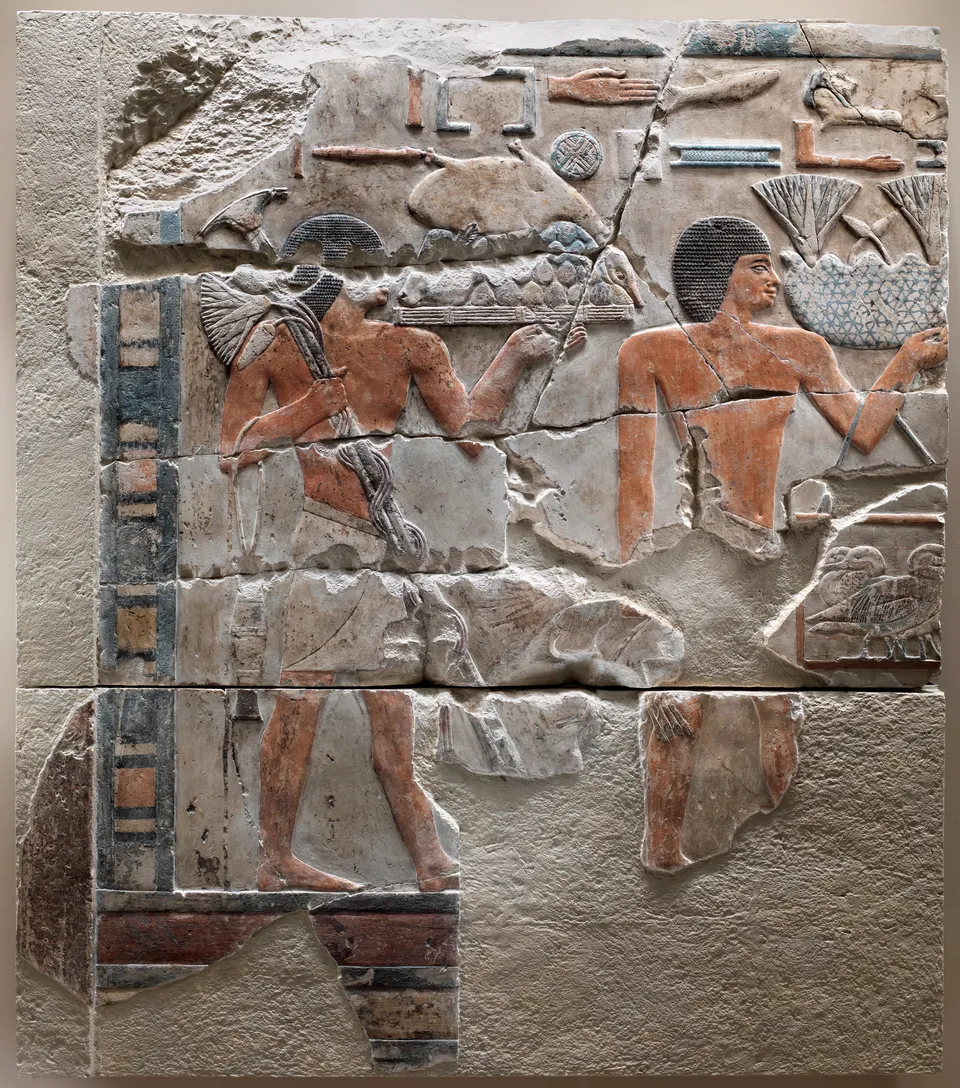
- Food on a tray
The bearer on the left carries fruit and prepared poultry.
- Plants and birds
The bearer on the right carries flowers and birds in a cage.
- Titles above the figures
The museum identifies the men as officials from the inscriptions. These annotations are not a sign-by-sign translation.
- A broken wall, surviving colour
The fragments preserve parts of a larger procession. Missing portions remain missing in this view.
Figure sources: Reference 1
First Intermediate Period c. 2181–2055 BCE
Regional Egypt
The end of centralised Old Kingdom rule changed who could command resources. Regional histories and local objects make a more useful picture than a blanket label of collapse.
What changed when the centre weakened?
During the First Intermediate Period, competing rulers and stronger regional elites divided the authority once concentrated at the royal centre. Local circumstances varied. Courts associated with Herakleopolis and Thebes eventually became major rivals, though their overlapping histories survive unevenly in the records. The chapter boundary marks this broad transition in power.
The effects of weakened royal authority varied locally. Royal provisioning could fail while a household continued farming, or a provincial leader could gain influence while people elsewhere faced hardship. Establishing the extent of prosperity or loss requires more than the condition of a royal monument.
At cemeteries used from the late Old Kingdom into the early Middle Kingdom, the dating of individual objects affects that assessment: reassigning a group across a period boundary can change the apparent pattern of prosperity or loss.
Royal centres and provincial evidence
Selected places along the Nile, with north at the top.
Choose a place below to highlight it on the map.
Modern geographic reference; ancient channels and shorelines differed. Natural Earth · Terrain: Mapzen / USGS / NOAA
- Herakleopolis / Ihnasya
This was the royal centre associated with the Ninth and Tenth Dynasties.
- Qau
Tomb 462 preserved pottery and a copper mirror. Its date lies around the late Old Kingdom–First Intermediate transition.
Read related section - Thebes / Luxor
The Theban Eleventh Dynasty produced Mentuhotep II, who reunited Egypt.
- Beyond the courts
Local pottery, coffins and relief styles add evidence that a list of kings cannot supply.
Read related section
Figure sources: Reference 1 · Reference 2 · Reference 3
Burials at Qau and Badari
A copper mirror and pottery were recorded together in Qau tomb 462. Its owner’s sex remains unknown.
The burial dates to the late Sixth Dynasty or the beginning of the following period, depending on the chronology used. Studying the mirror with its accompanying vessels preserves the relationships within the burial; a modern association between mirrors and gender cannot identify their ancient user. Across the cemeteries of Qau and Badari, such groups can be compared with ornaments and tomb construction to investigate access to materials and changing customs.
More graves can reflect a larger population, longer use, a shift in burial location or different preservation and excavation conditions. Cemetery size alone cannot establish a sudden rise in deaths.
An image can name a relationship
A provincial stela is a compact statement about who should be remembered and who could help sustain that memory. The owner’s figure, offerings, titles and named associates work together. Start with those relationships before judging the carving against the finish of a court workshop. A difference in style is evidence to investigate, not a measure of the maker’s intelligence or the community’s worth.
The stela of the gatekeeper Maati provides a useful boundary case. It belongs to the early reign of Mentuhotep II and names connections with important Theban figures. The Met catalogues it around 2051–2030 BCE and calls the period First Intermediate, a convention different from this guide’s approximate 2055 BCE division. We retain the object’s catalogue date rather than altering it to make the labels agree.
Maati’s limestone stela is now in New York and probably came from the Tarif area at Thebes. Its offering scene concerns remembrance and provision for the dead. The named associates place Maati within a Theban network, connecting his commemoration to the political relationships of the time.
How much can silence tell us?
The regional diagram locates centres discussed in the evidence; it does not turn every findspot into a political border. Distinguish what survives from what we infer. A surviving wall establishes a structure; the reconstruction of its height may depend on comparison; the activities of unnamed occupants may remain beyond recovery. The different levels of confidence should remain visible even when the drawing is attractive.
Egyptian texts also have purposes. A ruler’s account of restoring order presents a justification for rule. An official’s claim to have fed his community may describe real action while also building a reputation. Neither kind of statement should be discarded merely because it is self-interested, but it needs comparison with other records and excavated material.
Political changes and environmental pressures figure in explanations for the end of the Old Kingdom. Their timing, regional effects and relative weight remain debated. Low floods put crops under pressure, while succession disputes, alliances and administrative choices shaped how rulers and communities dealt with their circumstances.
Regional cemeteries preserve household objects alongside the monuments of competing rulers. The next chapter returns to the earlier royal centre and the large pyramid projects, whose construction drew resources from communities across the country.
Old Kingdom c. 2686–2181 BCE
We have reached the third millennium BCE. Giza’s great pyramids were already ancient when New Kingdom kings built their tombs at Thebes.
The pyramid kingdoms
A pyramid was part of a larger working institution: temples, roads, quarries, boats, fields, workshops and people. Its stone survives better than most of that supporting world.
The royal funerary complex
The Old Kingdom pyramids were royal funerary monuments. Their purpose is explained by their burial spaces, associated temples, cemeteries and the institutions that maintained offerings. At Giza, the pyramid itself occupies only one part of a designed landscape. A temple beside it, a causeway and a valley temple connected desert monument and river-edge activity, with important differences between individual complexes.
This distinction also answers a common question about temples and tombs. A tomb provided a place for burial and continuing provision for the deceased. A deity temple housed and served a divine cult. A royal funerary complex could include temple buildings connected to the dead king. The categories are related; the word temple alone does not tell you whether you are standing inside a burial place.
A cutaway makes the relationship between exterior mass and interior spaces easier to understand. It does not show every block or answer every construction question. Our figure is schematic: use it to locate passages and chambers, then return to the physical monument’s scale. Any proposed lifting system belongs to a separate argument, with different evidence from the surveyed passage layout.
The missing casing changes how a pyramid looks. What appears now as stepped masonry should not automatically be treated as the intended finished surface. Likewise, broken temple walls do not show the full height or colour of their ancient decoration. A present view combines original building, damage, stone removal and later conservation.
Khufu’s pyramid: mass and passage
A cutaway connects selected chambers and passages inside Khufu’s pyramid.
- North entrance and descending passage
A passage descends from the north side toward a chamber cut into bedrock.
- Ascending passage and Grand Gallery
The upward route leads toward the higher chamber. The gallery is much taller than the adjoining passage.
- “Queen’s Chamber”
A horizontal passage reaches the intermediate chamber. The conventional name does not establish a queen’s burial here.
- “King’s Chamber”
The upper chamber contains a granite coffer. Room positions do not by themselves reveal the building sequence.
Optional. Rotate with buttons; the cutaway and descriptions above carry the same information.
Figure sources: Reference 1
Giza had predecessors
Before Giza came Snefru’s projects at Dahshur and Meidum, and before those, Djoser’s Step Pyramid complex at Saqqara. Each monument underwent its own changes during construction. Their separate locations and building histories show the decisions through which pyramid architecture developed.
Djoser’s complex translated elements of royal architecture into stone on an ambitious scale. Buildings and courts had ritual roles alongside the underground burial arrangements. The pyramid did not stand alone like a geometric exercise. The surrounding enclosure and ceremonial spaces helped sustain the king’s identity and actions beyond death.
Snefru’s monuments show that pyramid building developed through different structural solutions. Khufu’s Great Pyramid at Giza belongs to the Fourth Dynasty, in the third millennium BCE. Cleopatra ruled in the first century BCE, roughly two and a half millennia later. The gap matters more here than a day-specific age: the pyramids were already deeply ancient within ancient Egyptian history.
Later Old Kingdom kings generally built smaller pyramids while investing in associated temples and decoration. Size is therefore an unreliable scorecard for religious importance or political competence. Different choices of masonry, relief programme, cult organisation and setting can make two royal complexes unlike each other even when both have a familiar triangular profile.
Who built and supplied the pyramids?
The strongest answer begins with excavated work and supply systems. At Heit el-Ghurab, south of the Sphinx, AERA has investigated a Fourth Dynasty settlement associated with the royal building projects. Streets, workshops, storage facilities, houses and administrative spaces reveal a community supporting construction. Its best-attested associations include Khafre and Menkaure; an attribution of every excavated room directly to Khufu would go beyond the evidence.
The people who hauled stone depended on people who baked, brewed, repaired tools, managed stores and transported materials. Farmers and herders beyond the site also belonged to that system. Building a pyramid mobilised labour across distances; counting only the people on a ramp would miss much of the work.
This evidence challenges the popular picture of an anonymous mass of slaves as a complete explanation. It does not establish that every worker participated voluntarily. Organised rations, skilled roles and nearby housing are compatible with unequal obligations and state demands. We should distinguish forms of labour and dependence rather than replace one absolute claim with another. The site does not preserve a contract for each person.
Nor was everyone’s experience identical. A supervisor’s residence and a food-production area served different roles. Archaeology can help recover those differences without inventing a worker’s thoughts or treating a royal project as proof of universal contentment.
A settlement behind the pyramids
Heit el-Ghurab, Giza, Fourth Dynasty: the activities that supported a working community.
- Grain storage
Large silos supported organised food supply.
- Bread and beer
Food production sustained the settlement’s workforce.
- Craft and administration
Workshops, tools and offices point to specialised work and coordination.
- Houses and transport
Homes formed part of the town. Waterways brought materials during the inundation; land routes also mattered.
Figure sources: Reference 1
Bread pots and a boat crew’s records
At Giza, bread molds and baking installations give food production a physical presence. AERA’s experimental work compared archaeological remains with tomb scenes and attempts to bake in replica equipment. Such experiments test possibilities. A successful modern batch would not prove the exact ancient recipe, and a failed batch need not show that the ancient method failed. A bakery needed fuel and water as well as prepared grain. Baking installations occupied space, required maintenance and left ash from repeated firings. Measuring these traces helps researchers estimate the work involved in feeding a construction community day after day.
The Wadi el-Jarf papyri offer a different kind of evidence. Found at a Red Sea harbor, the logs associated with the inspector Merer describe a crew moving limestone from Tura toward Khufu’s pyramid project at Giza. Findspot and narrated activity differ: a document discovered beside the Red Sea can describe work on the Nile.
The archive also records supplies and coordinated teams. It connects named supervision with transport, scheduling and resources. It does not give a complete step-by-step construction manual for the Great Pyramid. The very specificity of the record is its strength: we can identify a real part of the process without making it explain every unresolved engineering question.
Reliefs, offerings and words for the afterlife
A tomb relief showing food, animals or estate work has two kinds of value. It preserves observations of tools and activities, and it helps create an enduring provision for the tomb owner. The second purpose shapes the first. An abundant harvest on a chapel wall is not an agricultural survey of every village in the reign.
The relief-reading figure in the Middle Kingdom chapter provides a later comparison, not an Old Kingdom object. Follow its register lines, carried goods and relation between figures. Scale can express importance; a composition can group actions that did not occur together at one instant. These conventions are part of the picture’s meaning, so they should not be corrected into modern perspective.
The Pyramid Texts appear in the surviving royal record from the pyramid of Unas onward. They combine utterances intended to protect, transform and sustain the dead king, drawing on more than one religious association. The Great Pyramid of Khufu is earlier: do not project these later inscribed chamber walls into its interior.
Later royal and elite monuments make the continuing relationship between living and dead visible through offerings, images and names. What survives favors people with access to durable tombs. The beliefs and burial practices of poorer households cannot simply be reconstructed by shrinking the king’s equipment. The gap in preservation belongs in the story alongside the carved stone.
Early Dynastic Period c. 3100–2686 BCE
The first dynasties
Royal names, sealed containers and large mud-brick monuments reveal a state taking shape. Unification was a historical process, not a scene that one object can fully document.
Building a royal administration
The first dynasties inherited centuries of regional development. Increasingly powerful centres in Upper Egypt, including Abydos and Hierakonpolis, participated in the process that joined the valley and Delta under royal government. Conflict, exchange and institutional growth all belong in the explanation. A map with two solid blocks merging at one instant would suggest a precision that the evidence cannot provide.
A king’s claim and the practical reach of government are different things. To exercise authority across the country required relationships with local leaders, ways to collect and distribute resources, and people who could make decisions in the ruler’s name. Royal images make an assertion of command visible; sealings, stores and settlement evidence help us investigate how that command operated.
Dynasties group rulers within a historical sequence whose successions were not always father to son. Later king lists organised that sequence retrospectively. For the earliest reigns, contemporary objects often preserve a royal name more securely than the events of a life, leaving many biographies sparse. Our approximate start around 3100 BCE follows the guide’s chosen convention. Other scholarly chronologies place the opening of Dynasty 1 differently. The broad sequence is more reliable than a calendar-perfect coronation date, and names such as Dynasty 0 are modern tools for discussing rulers before the numbered First Dynasty.
What the Narmer Palette actually shows
On the Narmer Palette, the king appears with the White Crown on one face and the Red Crown on the other. His image asserts domination through a formal arrangement of ruler, attendants, captives and divine signs. The original was found at Hierakonpolis and belongs to the Egyptian Museum in Cairo. It is a ceremonial object whose meaning extends beyond a record of one afternoon’s battle.
It is often used to introduce the unification of Upper and Lower Egypt. That is a useful association, provided the palette is not asked to prove every detail of the process. The pictures make a royal claim; they do not give us the duration of campaigns, the negotiations between communities, or the experience of people who became subjects.
Narmer’s name appears within a serekh, a frame related to a palace façade. Later monuments commonly enclose royal names in the oval cartouche. These changing frames help locate an inscription within the long development of royal writing.
When you examine an image like this, begin with what you can point to: the crown, the relative size of figures, the objects carried and the placement of the name. Then ask what those choices communicate.
Writing attaches information to things
Early writing is often small. Tags, jar inscriptions and seal impressions connect signs with goods, institutions and royal authority. An ivory label pierced for attachment is a useful reminder that a text can be part of a container’s working life. Once detached and placed in a museum case, that physical relationship can be easy to miss.
A seal impression is also an action preserved in clay. Someone used a carved seal to mark or secure something. The resulting pattern may identify an office or ruler, but the location of the sealing and its association with a door, vessel or store matter. A royal name alone is less informative than a royal name in a well documented assemblage.
Hieroglyphs express sounds as well as words and categories of meaning. Reading an early inscription therefore requires more than recognising the objects pictured. Short texts offer little grammar, and some signs remain difficult to interpret because their later meanings may not apply to the earliest examples.
The early-writing example brings the inscribed object into view. Distinguish the script, the language and the material that carries a text. These are separate choices. Egyptian could be written in different scripts over its long history; stone, pottery and papyrus imposed different practical conditions. A change of medium is not automatically a change of language, and the first surviving sample is not necessarily the first time anyone wrote.
Small labels and royal images
Three kinds of Early Dynastic evidence for writing.
- Labels for vessels
First Dynasty ivory, bone and wooden labels combine images and brief inscriptions. Some identified oil vessels.
- A small cylinder seal
Met object 10.130.1602 is a First Dynasty seal made of steatite. Its length is 2.1 cm.
- Narmer’s palette
The Hierakonpolis palette brings writing into a royal image. Narmer wears different crowns on its two faces.
Figure sources: Reference 1 · Reference 2 · Reference 3
Abydos and the northern centre
The royal cemetery at Umm el-Qaab in Abydos preserves the burial places of early kings. Their mud-brick tombs and associated enclosures differ from the stone pyramid complexes encountered later. The enclosures and tombs are separate parts of the royal landscape. They should not be collapsed into a single outline simply because both belong to a funerary institution.
At North Abydos, the standing enclosure known as Shunet el-Zebib belongs to Khasekhemwy of the Second Dynasty. Its survival lets mud-brick architecture take a place in a story too often dominated by stone. Conservation here involves a vulnerable material whose exposed surfaces need care; a surviving ancient wall is not indestructible.
The Memphite region became a major focus of government near the meeting of valley and Delta. The ancient city shifted over time as the river landscape changed. Modern Mit Rahina and the visible monuments there do not represent one unchanged capital plan from the First Dynasty onward. Tombs, settlement remains and later monuments need their own dates.
Near the meeting of valley and Delta, Memphis connected royal government with river routes and surrounding settlements. Making that position into a functioning capital required labour, institutions and political decisions over successive reigns. The city’s archaeological remains document parts of that continuing work.
The people beyond the royal name
The concentration of resources around a royal burial makes power unusually visible. It also raises questions about who supplied the materials, who worked on construction and whose own graves received less attention. A large monument records an achievement and an imbalance in resources at the same time. Both belong in its explanation.
Small objects bring a different scale into view. A label might require a maker, a writer and someone responsible for the goods it marked. A stone vessel implies access to raw material and trained hands. These are cautious inferences about tasks, not permission to assign every object to a named occupation or to reconstruct a complete workshop from one find.
Early royal histories are also incomplete family histories. A named woman in a royal context can have a significant institutional role, but gaps in the sources should not be filled with imagined conversations or confident accounts of private motives. The same restraint applies to kings: images of victory do not disclose their personalities.
Earlier Predynastic communities left fewer royal names and a broader field of regional objects and practices. In the next chapter, pottery, graves and settlements take the lead in tracing their lives and connections.
Predynastic Period Broadly the sixth–fourth millennia BCE
Before the pharaohs
Different communities made different choices about settlement, food, burial and exchange. Their material traditions reveal connections without turning every pottery style into a people or a kingdom.
One label, several regional histories
Predynastic means before the numbered dynasties. It is a retrospective label, not the name these communities used for themselves. In this guide the chapter opens broadly in the sixth millennium BCE to include the development of food-producing communities, then follows the regional traditions of the fifth and fourth millennia. Dates and terminology vary by region.
Badarian and Naqada are archaeological names derived from places where important material was studied. In Lower Egypt, Maadi and Buto anchor another set of traditions. These labels help compare pottery, burial and settlement patterns. They do not give us a complete ethnic identity, a spoken language or a political boundary for every person who used a particular vessel.
Trade, imitation, the movement of craftspeople and changing preferences could spread a pottery style between communities. A claim of political expansion needs additional evidence. By the later fourth millennium, some practices and objects were more widely shared as Upper Egyptian centres gained influence, while local traditions continued within the developing state.
A pot is a sequence of decisions
A handmade vessel took shape through choices about clay, added material, wall thickness and surface treatment, followed by carefully managed firing. A polished surface or balanced profile records the maker’s skill. Such vessels preserve workshop decisions from communities that lived before royal writing.
Black-topped pottery stands out in Predynastic collections through the contrast between its dark rim and red or brown body. That finish was produced during manufacture. Dating a vessel requires comparison of its full shape and archaeological context, since similar surfaces persisted over time and museum dates remain open to revision.
Painted vessels introduce boats, animals and patterned designs. Their images can tell us which forms mattered to their makers and users, but assigning every motif a fixed religious translation is risky. A boat image does not tell us exactly how a boat was built, and a repeated sign is not automatically a fully deciphered hieroglyph.
Use the comparison figure to examine the rim, base, surface and signs of use. Then read the findspot: where a vessel was found helps connect the maker’s work with the people who used it.
Two pots, different choices
Two pottery objects, with dates from their individual museum catalogues.
- Black-topped beaker
Cleveland 1920.1980: Nile silt pottery, about 4000–3500 BCE. A polished red body contrasts with a dark rim.
- White cross-lined bowl
Met 10.176.107: pottery and paint, about 3700–3500 BCE. The bowl rests on four legs.
- Compare the choices
Notice the tall vessel and the supported bowl, the contrasting rim and the painted surface. Two objects show variation, not a complete history of pottery.
Figure sources: Reference 1 · Reference 2
Food and movement around the Fayum lake
The Fayum provides evidence for communities combining cultivated crops and domestic animals with other ways of obtaining food. Excavated storage pits, plant remains, animal bones and stone tools offer different parts of that picture. The presence of grain does not by itself establish that every person lived permanently in a village or that fishing and gathering immediately ceased.
Research around Kom K and Kom W asks how people moved and used resources around the lake. A large spread of artefacts could accumulate through repeated visits as well as continuous occupation; the deposits and their local setting help distinguish those possibilities.
Basketry is another reminder of skills that seldom survive. Early Fayum baskets and Predynastic examples show that containers and woven materials belong in the history alongside ceramics. Their scarcity in many excavations reflects preservation as well as original use. A museum shelf dominated by pottery can exaggerate pottery’s share of everyday equipment.
Households combined the resources available around them. The lake margins of the Fayum, the Nile Valley and the desert offered different possibilities, even as people moved between them. Crops and domestic animals spread within these connected landscapes at varying rates.
Care for the dead, differences among the living
Predynastic graves contain vessels, ornaments and other objects selected for the deceased. Some had been used in life; others may have been made for burial or acquired a new meaning there. Their arrangement records choices around death, although the beliefs behind those choices are only partly recoverable.
Some graves are much larger or more richly furnished than others. This supports an argument for social differentiation, especially when patterns recur across a cemetery. It does not let us translate each quantity of goods into an exact wealth ranking. A burial was also an action taken by survivors, shaped by ritual, age, identity and circumstances.
Natural preservation and intentional treatment need to be distinguished through analysis of the remains and burial materials. Early communities had their own practices; later royal mummification provides no universal standard for judging them.
How can we date a time before king lists?
Relative dating establishes a sequence before assigning calendar years. A sealed deposit below another deposit, or recurring combinations of pottery in graves, can establish relationships that further finds help test.
Radiocarbon measurements add estimates from suitable organic material, with uncertainty ranges and calibration. The date belongs first to the sample: reused wood and a short-lived seed can have different relationships to the event being dated.
The earliest collections were often assembled through practices that kept some information and lost other information. A vessel with a recorded grave group allows questions that a purchased object without context cannot answer. Modern reanalysis can recover much from old records, but it cannot always recreate an excavated relationship that nobody documented.
Together, stratigraphy, comparisons between objects and calibrated radiocarbon dates establish sequences before readable king lists. These methods trace regional connections, technologies and differences in access to resources, even where the names of rulers and households remain unknown.
Earlier prehistory Earlier prehistory; dates differ by region
Before dynasties and royal dates, the sequence comes from changing landscapes, settlements and material remains.
Before a kingdom, and before writing
Long before royal Egypt, people learned landscapes, made tools and sustained communities across changing environments. Their lives deserve attention without being treated only as a prelude to the pyramids.
The scale of time changes
Stone tools record human activity long before agriculture, writing or a united Egyptian state.
Earlier prehistory spans far more time than the royal chapters. Its sequence comes from dated material traces, including tools, deposits and remains of food or fire. Sites, technologies and environmental changes each have their own chronology; a single national starting date would obscure those differences.
Palaeolithic and Neolithic are archaeological terms for broad patterns in technologies and ways of life. Making a flaked stone tool required practised judgement about material, angle and force. Knowledge of plants, animals and water sustained communities long before written records.
The name Egypt locates much of this evidence on a modern map. The people who left it lived before its royal identity and modern borders, with connections across areas now divided between Egypt, Sudan, Libya and the Levant.
Water and settlement in the eastern Sahara
Parts of the eastern Sahara had substantially wetter conditions during the early and middle Holocene. Archaeological sites, former lake deposits and dated organic remains allow researchers to compare occupation with environmental change. Different regions responded at different times. A single lush-green map labelled prehistoric Egypt would be as misleading as treating today’s aridity as permanent.
A major synthesis by Rudolph Kuper and Stefan Kröpelin relates changing occupation patterns to the onset of wetter conditions and subsequent drying across the eastern Sahara. Its broad environmental argument is influential, but a regional synthesis is not a travel diary for an individual community. Dates on a climate figure should identify the model and its uncertainty rather than imply that rain stopped everywhere on one day.
Water availability influenced where people could remain and how they moved. It did not prescribe one inevitable political future. Movement toward the Nile was one part of a larger regional history that also included refuges, southward movement and changing pastoral strategies. The emergence of the later Egyptian state requires social and political explanations as well as environmental ones.
The schematic places water, cultivated ground and desert edge alongside one another. It represents no particular prehistoric phase or migration route.
Valley, floodplain, desert edge
Follow the relationship between the river valley, desert and settlement.
- River and wet ground
Water connected settlements and supported marsh plants.
- Cultivated land
Cultivated ground lay beside the river and its wet margins.
- Desert edge
Dry ground and river access shaped where different activities could take place.
Figure sources: Reference 1 · Reference 2
What a stone tool can tell us
A stone tool has a life before it enters a museum. Someone selected raw material, shaped it, used or carried it, perhaps sharpened it again, and finally left it where it could survive. Studying that sequence can reveal work and movement. The discarded flakes from making a tool may be as informative as the finished object. Flint and chert served for cutting and scraping across a long history in Egypt, continuing into the dynastic periods alongside metal. Their sharp edges and availability made them useful for particular tasks. Craftspeople worked with several materials, retaining stone where its properties suited the job.
Wind, erosion and later disturbance can bring surface finds of different ages together. Systematic survey records their distribution and geological setting; excavation can sometimes recover relationships lost on the surface.
A tool’s shape helps researchers propose a task or identify a technological tradition. Wear, associated finds and the conditions of discovery help test those proposals. The maker’s name and language usually remain beyond reach; a well documented tool still records skilled choices about material and use.
Several ways to make a living
Communities combined hunting, fishing and gathering with herding or cultivation according to place, season and available resources. Social choices also shaped those combinations. A grain store records one part of provisioning; other foods and seasonal activities require their own traces.
In the Fayum, the lake and its changing margins created opportunities different from those of the open desert or the narrow southern valley. Research has questioned simple models in which a fixed package of crops, animals and permanent villages arrived all at once. Material evidence can instead be used to investigate mobility, storage and different degrees of dependence on cultivated foods.
The preservation of plant remains matters to that investigation. A burnt seed can survive where an unburnt meal disappeared. Animal bones may be filtered by preservation and excavation methods. An assemblage is therefore not a complete menu. Researchers compare multiple kinds of evidence and ask how each entered the deposit.
Feeding households, caring for children and learning dependable routes occupied people across these changing landscapes. Tools and food remains preserve parts of that work. The different combinations found at each site show how communities made use of their surroundings.
- UCL Discovery · An archaeological survey in the northeastern part of the Fayum
- Quaternary International · Mid-Holocene occupation of Egypt and global climatic change
- Quaternary International / UCLA repository · Basket use, raw materials and arguments on early and Middle Holocene mobility in the Fayum, Egypt
What remains, and what remains unknown
The earliest chapters are often encountered through museum objects and research reports rather than standing monuments. A stone scatter, an ancient shoreline or a buried hearth may carry historical information without presenting an obvious attraction to an untrained eye. Some sites are fragile research landscapes; their inclusion here is not an assertion of visitor access.
Conservation starts with relationships as well as objects. Removing a tool from the ground can destroy the information carried by its position among other finds. Recording, sampling and preserving a site require permission, skilled work and an account of what was changed. A find becomes more useful when its context can be checked by others.
Modern archaeological knowledge depends on fieldworkers, conservators, surveyors, laboratory specialists and researchers, including Egyptian teams and the institutions responsible for the sites. A discovery caption that names only an expedition director can hide much of the labour that made the interpretation possible. Where the surviving record does not preserve all names, we should acknowledge that limitation instead of inventing them.
The route ends here because the written royal histories have given way to much older traces of human choices. You can return to a pyramid, a temple relief or a household object with a broader question: what had to exist around it for someone to make and use it? The answer reaches beyond kings, and often beyond the boundaries of a single chapter.
YOUR PRIVATE EGYPT TRIP
See ancient Egypt for yourself.
Choose the places you’d like to explore. We’ll use your interests to help shape a private trip through Egypt.
Next, tell us your dates, who’s coming and how you like to travel.
Your choices stay in this browser. Adding them to a trip request does not subscribe you to marketing.
Names & terminology
Names can appear in different spellings. These aliases help you find the same person, place or idea.
- Shenoute
- Shenoute of AtripeThe ancient world transforms
- White Monastery
- The ancient world transforms
- Augustus
- OctavianEgypt within the Roman world
- Karanis
- Kom AushimEgypt within the Roman world
- Temple of Dendur
- Egypt within the Roman world
- Tebtunis
- Egypt within the Roman world
- Cleopatra VII
- CleopatraCleopatra’s world and its predecessors
- Alexander the Great
- AlexanderCleopatra’s world and its predecessors
- Dendera
- DendaraCleopatra’s world and its predecessors
- Naukratis
- NaucratisCleopatra’s world and its predecessorsThe Late Period
- Rosetta Stone
- Cleopatra’s world and its predecessors
- Darius I
- DariusThe Late Period
- Nectanebo II
- The Late Period
- Sais
- Sa el-HagarThe Late Period
- Taharqo
- TaharqaSeveral centres of power
- Sheshonq I
- Shoshenq ISeveral centres of power
- Tanis
- San el-HagarSeveral centres of power
- Ramesses II
- Ramses II · Rameses IIThe New Kingdom
- Deir el-Medina
- The New Kingdom
- Karnak
- The New Kingdom
- Hatshepsut
- The New Kingdom
- Thutmose III
- Thutmosis IIIThe New Kingdom
- Akhenaten
- Amenhotep IVThe New Kingdom
- Nefertiti
- The New Kingdom
- Tutankhamun
- TutankhamenThe New Kingdom
- Horemheb
- HaremhabThe New Kingdom
- Amarna
- AkhetatenThe New Kingdom
- Ahmose I
- The New Kingdom
- Amun
- Amun-ReThe New KingdomSeveral centres of power
- Anubis
- The New Kingdom
- Aten
- The New Kingdom
- Avaris
- Tell el-Dabaa · Tell el-Dab’aA divided political landscape
- Kerma
- Kingdom of Kerma · KushA divided political landscape
- Buhen
- Buhen fortressThe Middle KingdomA divided political landscape
- Rhind Mathematical Papyrus
- Ahmose mathematical papyrus · EA10057A divided political landscape
- Ahmose, the Rhind copyist
- Ahmes · Rhind scribeA divided political landscape
- Edwin Smith Papyrus
- Surgical papyrusA divided political landscape
- Mentuhotep II
- Nebhepetre · Mentuhotpe IIThe Middle KingdomRegional Egypt
- Amenemhat I
- Amenemhet IThe Middle Kingdom
- Senusret III
- Senwosret III · Sesostris IIIThe Middle Kingdom
- Lahun
- el-Lahun · KahunThe Middle Kingdom
- The Tale of Sinuhe
- Sanehat · SinuheThe Middle Kingdom
- Wah
- Estate manager WahThe Middle Kingdom
- Offering bearers from Lisht South
- 09.180.13a,b · Senusret I offering reliefThe Middle Kingdom
- Stela of Maati
- Gatekeeper Maati · 14.2.7Regional Egypt
- Qau el-Kebir
- Qau · TjebuRegional Egypt
- Khufu
- CheopsThe pyramid kingdoms
- Snefru
- Sneferu · SnofruThe pyramid kingdoms
- Djoser
- Netjerikhet · ZoserThe pyramid kingdoms
- Heit el-Ghurab
- Lost City of the Pyramids · Giza workers settlementThe pyramid kingdoms
- Merer
- Inspector MererThe pyramid kingdoms
- Narmer
- Narmer kingThe first dynasties
- Narmer Palette
- Palette of NarmerThe first dynasties
- Abydos
- Umm el-Qaab · AbdjuThe first dynastiesThe Middle Kingdom
- Memphis
- Memphite region · Ineb-hedjThe first dynastiesThe pyramid kingdoms
- Naqada traditions
- Naqada I · Naqada II · Naqada IIIBefore the pharaohsThe first dynasties
- Fayum
- Faiyum · Fayoum · Kom K · Kom WBefore the pharaohsBefore a kingdom, and before writing
- Stone-tool production
- Flint · Chert · Knapping · LithicsBefore a kingdom, and before writingBefore the pharaohs
- Changing Saharan environments
- Holocene · Aridification · Green SaharaBefore a kingdom, and before writing
EGYPTMORE
Sources & further reading
Chapter notes link to the records below. Source titles are retained in their original language.
An editorial guide based on linked scholarly, museum and archaeological sources. Dates and interpretations remain open to revision as research develops.
Sources last reviewed:
View all 158 sources
- Digital Egypt: Chronology ↗
University College London
- Isis and Horus ↗
The Metropolitan Museum of Art
- Provinces of Egypt ↗
UCL Digital Egypt
- Fayum ↗
UCL Digital Egypt
- Conservation Archives ↗
American Research Center in Egypt
- Nubian Monuments from Abu Simbel to Philae ↗
UNESCO World Heritage Centre
- Housing Survey ↗
Amarna Project
- How Egyptian hieroglyphs were decoded: a timeline ↗
British Museum
- Eureka! Finding the key to ancient Egypt ↗
British Museum
- The Church of St. Shenoute ↗
Yale Egyptology
- Shenoute and the History of the Monastic Federation ↗
Yale Egyptology
- Luxor Roman Wall Paintings ↗
ARCE Conservation Archives
- Fashion and Style in Byzantium ↗
The Metropolitan Museum of Art · Nazanin Hedayat Munroe
- Roman Egypt ↗
The Metropolitan Museum of Art · Departments of Egyptian Art and Greek and Roman Art
- Domestic Life at Karanis ↗
Kelsey Museum, University of Michigan
- See the Faces of People Who Lived in Egypt under the Roman Empire ↗
J. Paul Getty Museum · Yousra Rebbani
- Mummy Portraits of Roman Egypt: Introduction ↗
Getty Publications
- The Temple of Dendur, 68.154 ↗
The Metropolitan Museum of Art
- Library of Tebtunis ↗
UCL Digital Egypt
- Egypt in the Ptolemaic Period ↗
The Metropolitan Museum of Art · Marsha Hill
- The Rosetta Stone: everything you need to know ↗
British Museum
- Naukratis: Greeks in Egypt ↗
British Museum
- Naukratis ↗
UCL Digital Egypt
- Dendara ↗
Griffith Institute, University of Oxford
- Timeline of ancient Egypt ↗
British Museum
- Late Period ↗
UCL Digital Egypt
- Achaemenid Iranian rule over Egypt: 525–404 BC ↗
UCL Digital Egypt
- Darius ↗
UCL Digital Egypt
- Divine creatures: animal mummies in ancient Egypt ↗
British Museum
- Guided Tour: Late Period ↗
UCL Digital Egypt
- Sheshonq I ↗
UCL Digital Egypt
- Psusennes I ↗
UCL Digital Egypt
- Re-evaluating Kush’s sacred landscape ↗
British Museum
- Shabti of Taharqo, EA55483 ↗
British Museum
- Property and the God’s Wives of Amun ↗
Center for Hellenic Studies, Harvard University · Betsy M. Bryan
- Matmar ↗
UCL Digital Egypt
- Outer Coffin of Menkheperre (C), usurped from Ahmose ↗
The Metropolitan Museum of Art
- Egypt in the New Kingdom (ca. 1550–1070 B.C.) ↗
The Metropolitan Museum of Art · Catharine H. Roehrig
- Deir el-Medina ostraca ↗
UCL Digital Egypt
- The wise woman at Deir el-Medina ↗
UCL Digital Egypt
- The First Recorded Strike in History ↗
Papyrus Stories · Jennifer Cromwell
- Marginal Decoration ↗
University of Memphis, Karnak Great Hypostyle Hall Project
- North Gateway ↗
University of Memphis, Karnak Great Hypostyle Hall Project
- Red Chapel ↗
UC Santa Cruz, Digital Karnak
- Thutmose III Shrine ↗
UC Santa Cruz, Digital Karnak
- The Female Pharaoh Hatshepsut, 29.3.3 ↗
The Metropolitan Museum of Art
- Queen Hatshepsut Restored ↗
The Metropolitan Museum of Art
- Art, Architecture, and the City in the Reign of Amenhotep IV / Akhenaten ↗
The Metropolitan Museum of Art
- The Amarna Letters ↗
The Metropolitan Museum of Art
- Workmen’s Village ↗
Amarna Project
- Main City ↗
Amarna Project
- Canaanite amphorae ↗
Amarna Project
- Book of the Dead of Hunefer, EA9901,3 ↗
British Museum
- Healing papyri ↗
UCL Digital Egypt
- Divine Egypt ↗
The Metropolitan Museum of Art
- Temple of Dendera ↗
Egyptian Ministry of Tourism and Antiquities
- Late Dynastic Period ↗
UCL Digital Egypt
- Ptolemaic Egypt: Art ↗
UCL Digital Egypt
- Statue of Horus as a falcon protecting King Nectanebo II ↗
The Metropolitan Museum of Art
- Valley of the Kings ↗
Egyptian Ministry of Tourism and Antiquities
- Ramesses II ↗
UCL Digital Egypt
- 1992–2002 Field Report ↗
University of Memphis, Hypostyle Hall Project
- Tutankhamun’s World: A Self-Guided Tour ↗
The Metropolitan Museum of Art
- Haremhab: Ancient Egyptian General Who Became Pharaoh ↗
The Metropolitan Museum of Art
- Egyptian mathematics ↗
The Open University
- Papyrus Edwin Smith ↗
Saxon Academy of Sciences and Humanities in Leipzig
- Second Intermediate Period ↗
UCLA Encyclopedia of Egyptology · Alexander Ilin-Tomich
- Egypt in the Second Intermediate Period ↗
University College London
- What is The Hyksos Enigma Research Programme about? ↗
Austrian Academy of Sciences
- Who were the Hyksos? Challenging traditional narratives using strontium isotope analysis ↗
Durham University repository / PLOS ONE · Chris Stantis and colleagues
- Hyksos waren keine friedlichen Herrscher ↗
Austrian Academy of Sciences
- Buhen in the Middle Kingdom ↗
University College London
- Late Second Intermediate Period to Early New Kingdom ↗
UCLA Encyclopedia of Egyptology · Lutz Popko
- Rhind Mathematical Papyrus, EA10057 ↗
British Museum
- Edwin Smith Surgical Papyrus ↗
New York Academy of Medicine
- A healing papyrus from Lahun ↗
University College London
- Egypt in the Middle Kingdom ↗
Metropolitan Museum of Art · Adela Oppenheim
- A guided tour of Egypt in the Middle Kingdom ↗
University College London
- Senusret III ↗
University College London
- Lahun in the Middle Kingdom ↗
University College London
- Lahun: objects found at the site ↗
University College London
- The Lahun Papyri ↗
University College London
- Festivals in the ancient Egyptian calendar ↗
University College London
- Ancient Egypt Transformed: The Middle Kingdom family guide ↗
Metropolitan Museum of Art
- Tale of Sanehat ↗
University College London
- A Middle Kingdom library ↗
University College London
- A late Eighteenth Dynasty library ↗
University College London
- Egyptian Faience: Technology and Production ↗
Metropolitan Museum of Art · Carolyn Riccardelli
- Egyptian Tombs: Life Along the Nile ↗
Metropolitan Museum of Art · Catharine H. Roehrig
- The Magical Powers of Egyptian Faience ↗
Metropolitan Museum of Art · Pac Pobric
- Abydos ↗
University College London
- Relief showing procession of offering bearers, 09.180.13a,b ↗
Metropolitan Museum of Art
- Egypt in the First Intermediate Period ↗
University College London
- The Relative Chronology of the First Intermediate Period ↗
Brill · Stephan J. Seidlmayer
- The First Intermediate Period from an Epistemological Perspective ↗
University of Chicago, Oriental Institute · Thomas Schneider
- Qau el-Kebir ↗
University College London
- Qau tomb 462 ↗
University College London
- Qau: background ↗
University College London
- Stela of the Gatekeeper Maati, 14.2.7 ↗
Metropolitan Museum of Art
- Egypt in the Old Kingdom ↗
Metropolitan Museum of Art · Tara Prakash
- Frequently Asked Questions ↗
Harvard University, Digital Giza
- King Snefru ↗
University College London
- Lost City of the Pyramids ↗
Ancient Egypt Research Associates
- Social classes in ancient Egypt ↗
University College London
- Feeding the Pyramid Workers ↗
Ancient Egypt Research Associates
- Les papyrus de la mer Rouge I: Le journal de Merer ↗
Institut français d’archéologie orientale · Pierre Tallet
- Les papyrus de la mer Rouge II: annexes ↗
Institut français d’archéologie orientale · Pierre Tallet
- Pyramid Texts ↗
University College London
- Late Fourth Millennium BCE ↗
UCLA Encyclopedia of Egyptology · Marcelo Campagno
- Early Egypt, Room 64 ↗
British Museum
- Chronology ↗
UCLA Encyclopedia of Egyptology
- Narmer Palette ↗
Egyptian Ministry of Tourism and Antiquities
- Cast of the Narmer Palette, EA35714 ↗
British Museum
- Writing, art, and society: a contextual archaeology of the inscribed labels ↗
University College London · Kathryn E. Piquette
- Ivory label, EA35516 ↗
British Museum
- The Origins and Early Development of Writing in Egypt ↗
Oxford University Press · Ilona Regulski
- About the project ↗
Abydos Archaeology
- Hidden Treasures ↗
Penn Museum, Expedition
- Memphis: background ↗
University College London
- Prehistoric Regional Cultures ↗
UCLA Encyclopedia of Egyptology · Béatrix Midant-Reynes
- Predynastic burial customs ↗
University College London
- Basketry ↗
University College London
- An archaeological survey in the northeastern part of the Fayum ↗
UCL Discovery · Noriyuki Shirai, Willeke Wendrich and René Cappers
- Fayum Neolithic: Kom W and Kom K ↗
University College London
- Black-topped pottery bowl, 32.2.33 ↗
Metropolitan Museum of Art
- Dawn of Egyptian Art ↗
Metropolitan Museum of Art
- UCL Petrie Museum’s Tarkhan dress: world’s oldest woven garment ↗
University College London
- Stone Tool Production ↗
UCLA Encyclopedia of Egyptology · Thomas Hikade
- Middle Egypt in Prehistory ↗
Penn Museum, Expedition
- Climate-Controlled Holocene Occupation in the Sahara: Motor of Africa’s Evolution ↗
Science · Rudolph Kuper and Stefan Kröpelin
- Mid-Holocene occupation of Egypt and global climatic change ↗
Quaternary International
- After 5000 BC: The Libyan desert in transition ↗
Comptes Rendus Palevol · Rudolph Kuper
- Researchers in Museums: early stone tools in the Petrie Museum ↗
University College London
- Basket use, raw materials and arguments on early and Middle Holocene mobility in the Fayum, Egypt ↗
Quaternary International / UCLA repository · Willeke Wendrich and Simon Holdaway
- White Chapel ↗
Digital Karnak, University of California
- Hypostyle Hall ↗
Digital Karnak, University of California
- Khufu Pyramid: chambers and passage system ↗
Harvard University, Digital Giza
- Telling Time in Ancient Egypt ↗
The Metropolitan Museum of Art
- Ancient Faces: Mummy Portraits from Roman Egypt ↗
The Metropolitan Museum of Art
- Papyrus in Ancient Egypt ↗
The Metropolitan Museum of Art
- Architectural Features ↗
Digital Karnak, University of California
- Thutmose III ↗
University College London, Digital Egypt
- Third Intermediate Period ↗
University College London, Digital Egypt
- Dynasty 27 ↗
University College London, Digital Egypt
- Hatshepsut ↗
University College London, Digital Egypt
- 3rd Pylon ↗
University of California Santa Cruz, Digital Karnak
- Rome, Empire of Plunder — list of figures ↗
Cambridge University Press
- Ivory, bone and wooden tablets of the First Dynasty ↗
University College London, Digital Egypt
- Cylinder seal ↗
The Metropolitan Museum of Art
- Black-Topped Beaker ↗
Cleveland Museum of Art
- White cross-lined bowl with four legs ↗
The Metropolitan Museum of Art
- First Intermediate Period ↗
Egyptian Ministry of Tourism and Antiquities
- Ptah, 44.4.32 ↗
The Metropolitan Museum of Art
- Kings and Queens of Egypt ↗
The Metropolitan Museum of Art · Susan Allen
- Mummies and mummification ↗
UCL Digital Egypt
- Tutankhamun’s Funeral ↗
The Metropolitan Museum of Art · Dorothea Arnold
- The Art of Ancient Egypt: A Resource for Educators ↗
The Metropolitan Museum of Art
- Gods and goddesses in ancient Egypt: local deities ↗
UCL Digital Egypt
The opening photograph shows a surviving interior; its source does not identify the tomb. It is used for atmosphere, not as evidence for a named monument.
Back to the beginning ↑